Concerto for Sitar & Orchestra
| Concerto for Sitar & Orchestra | |
|---|---|
 | |
| Studio album by Ravi Shankar with the London Symphony Orchestra conducted by André Previn | |
| Released | November 1971 |
| Recorded |
January 1971 Abbey Road Studios, London |
| Genre | Indian classical |
| Length | 39:53 |
| Label | HMV, Angel |
| Producer | Christopher Bishop |
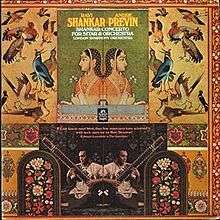
Concerto for Sitar & Orchestra is a studio album by Indian musician and composer Ravi Shankar with the London Symphony Orchestra (LSO) conducted by André Previn. It was released in 1971 on the EMI-owned record labels HMV and Angel, in Britain and America, respectively, after Shankar and Previn had premiered the eponymous concerto at London's Royal Festival Hall on 28 January that year.[1] The album was produced by Christopher Bishop and recorded at Abbey Road Studios in London.[2]
Shankar began composing the work, his first concerto, after receiving a commission from the LSO in mid November 1970.[3] The idea of creating an Indian classical work for a full Western orchestra, accompanied by his sitar, appealed to Shankar following his forays into chamber music with violinist Yehudi Menuhin[4] – issued on West Meets East (1967) and West Meets East, Volume 2 (1968).[5] He dedicated the concerto to his music guru (teacher) Allauddin Khan, who was in poor health at the time.[6] Khan's composition Raga Manj Khamaj was one of the four ragas that Shankar adapted for the project.[7][8]
The concerto received acclaim from some reviewers.[3] In America, the LP cover carried a quote from The Guardian's music critic, Edward Greenfield, that read: "If East has to meet West, then few musicians have achieved it with such open joy as Ravi Shankar."[9] According to author Peter Lavezzoli, however, other critics considered it to be "a bastardization of two distinct forms of music".[6] The US release of Concerto for Sitar & Orchestra, in November 1971,[10] coincided with the world premiere of Shankar's autobiographical film Raga.[11] The album peaked at number 6 on the Billboard Best Selling Classical LP's chart in February 1972.[12] In November that year, EMI's US affiliate, Capitol Records, described the commercial performance of the album as the company's "biggest surprise" of 1972, adding that it had "sold like a pop record".[13]
In addition to subsequent performances by Shankar, the concerto has been performed in concert by his daughter Anoushka Shankar.[14] The second and third movements – based on the ragas Sindhi Bhairavi and Adana[15] – were included on the four-disc box set Ravi Shankar: In Celebration (1996).[16] The LSO project led to further collaborations between Shankar and Western classical musicians, such as Zubin Mehta, who conducted his concerto Raga Mala in 1981.[17][18]
Track listing
All selections adapted by Ravi Shankar.
- Side one
- "1st Movement: Rāga Khamāj" – 14:23
- "2nd Movement: Rāga Sindhi Bhairavi" – 6:19
- Side two
- "3rd Movement: Rāga Adanā" – 3:37
- "4th Movement: Rāga Mānj Khamāj" – 15:34
Personnel
- Ravi Shankar – sitar
- André Previn – orchestral direction
- Terence Emery – bongos
- London Symphony Orchestra – strings, brass and woodwinds
References
- ↑ Shankar, pp. 215, 324.
- ↑ Concerto for Sitar & Orchestra (LP sleeve credits). Ravi Shankar. HMV. 1971.
- 1 2 Shankar, p. 215.
- ↑ Lavezzoli, pp. 220, 221.
- ↑ Shankar, pp. 323, 324.
- 1 2 Lavezzoli, p. 221.
- ↑ Concerto for Sitar & Orchestra (liner notes). Susan Regan, Ravi Shankar. HMV. 1971.
- ↑ Lavezzoli, pp. 221–22.
- ↑ Concerto for Sitar & Orchestra (LP front cover). Ravi Shankar. Angel Records. 1971.
- ↑ Billboard staff (27 November 1971). "Shankar, 'Raga' At Carnegie". Billboard. p. 16. Retrieved 29 August 2015.
- ↑ Shankar, p. 324.
- ↑ "Billboard Best Selling Classical LP's". Billboard. 5 February 1972. p. 42. Retrieved 29 August 2015.
- ↑ Kirsch, Bob (4 November 1972). "Cap Sees New Audience Other Than Revival". Billboard. p. 57. Retrieved 30 August 2015.
- ↑ Lavezzoli, p. 222.
- ↑ Ravi Shankar: In Celebration (booklet). Ravi Shankar. Angel/Dark Horse. 1996. pp. 42–43.
- ↑ Eder, Bruce. "Ravi Shankar Shankar: In Celebration". AllMusic. Retrieved 29 August 2015.
- ↑ World Music: The Rough Guide, p. 109.
- ↑ Lavezzoli, pp. 221, 228.
Sources
- Lavezzoli, Peter (2006). The Dawn of Indian Music in the West. New York, NY: Continuum. ISBN 0-8264-2819-3.
- Shankar, Ravi (1999). Raga Mala: The Autobiography of Ravi Shankar. New York, NY: Welcome Rain. ISBN 1-56649-104-5.
- World Music: The Rough Guide (Volume 2: Latin and North America, Caribbean, India, Asia and Pacific) (2000). London: Rough Guides/Penguin. ISBN 1-85828-636-0.