Convex polygon
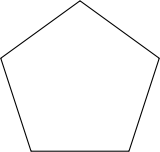
A convex polygon is a simple polygon (not self-intersecting) in which no line segment between two points on the boundary ever goes outside the polygon. Equivalently, it is a simple polygon whose interior is a convex set.[1] In a convex polygon, all interior angles are less than or equal to 180 degrees, while in a strictly convex polygon all interior angles are strictly less than 180 degrees.
A simple polygon which is not convex is called concave.
Properties
The following properties of a simple polygon are all equivalent to convexity:
- Every internal angle is less than or equal to 180 degrees.
- Every point on every line segment between two points inside or on the boundary of the polygon remains inside or on the boundary.
- The polygon is entirely contained in a closed half-plane defined by each of its edges.
- For each edge, the interior points are all on the same side of the line that the edge defines.
- The angle at each vertex contains all other vertices in its edges and interior.
- The polygon is the convex hull of its edges.
Additional properties of convex polygons include:
- The intersection of two convex polygons is a convex polygon.
- Helly's theorem: For every collection of at least three convex polygons: if the intersection of every three of them is nonempty, then the whole collection has a nonempty intersection.
- Krein–Milman theorem: A convex polygon is the convex hull of its vertices. Thus it is fully defined by the set of its vertices, and one only needs the corners of the polygon to recover the entire polygon shape.
- Hyperplane separation theorem: Any two convex polygons with no points in common have a separator line. If the polygons are closed and at least one of them is compact, then there are even two parallel separator lines (with a gap between them).
- Inscribed triangle property: Of all triangles contained in a convex polygon, there exists a triangle with a maximal area whose vertices are all polygon vertices.[2]
- Inscribing triangle property: every convex polygon with area A can be inscribed in a triangle of area at most equal to 2A. Equality holds (exclusively) for a parallelogram.[3]
- Inscribed/inscribing rectangles property: For every convex body C in the plane, we can inscribe a rectangle r in C such that a homothetic copy R of r is circumscribed about C and the positive homothety ratio is at most 2 and .[4]
- The mean width of a convex polygon is equal to its perimeter divided by pi. So its width is the diameter of a circle with the same perimeter as the polygon.[5]

Every polygon inscribed in a circle (such that all vertices of the polygon touch the circle), if not self-intersecting, is convex. However, not every convex polygon can be inscribed in a circle.
Strict convexity
The following properties of a simple polygon are all equivalent to strict convexity:
- Every internal angle is strictly less than 180 degrees.
- Every line segment between two points in the interior, or between two points on the boundary but not on the same edge, is strictly interior to the polygon (except at its endpoints if they are on the edges).
- For each edge, the interior points and the boundary points not contained in the edge are on the same side of the line that the edge defines.
- The angle at each vertex contains all other vertices in its interior (except the given vertex and the two adjacent vertices).
Every nondegenerate triangle is strictly convex.
See also
References
- ↑ Definition and properties of convex polygons with interactive animation.
- ↑ -, Christos. "Is the area of intersection of convex polygons always convex?". Math Stack Exchange.
- ↑ Weisstein, Eric W. "Triangle Circumscribing". Wolfram Math World.
- ↑ Lassak, M. (1993). "Approximation of convex bodies by rectangles". Geometriae Dedicata. 47: 111. doi:10.1007/BF01263495.
- ↑ Jim Belk. "What's the average width of a convex polygon?". Math Stack Exchange.
External links
 |
Wikimedia Commons has media related to Convex polygons. |
- http://www.rustycode.com/tutorials/convex.html
- Schorn, Peter; Fisher, Frederick (1994), "I.2 Testing the convexity of a polygon", in Heckbert, Paul S., Graphics Gems IV, Morgan Kaufman (Academic Press), pp. 7–15, ISBN 9780123361554