Cosmos atrosanguineus
| Cosmos atrosanguineus | |
|---|---|
 | |
| Scientific classification | |
| Kingdom: | Plantae |
| (unranked): | Angiosperms |
| (unranked): | Eudicots |
| (unranked): | Asterids |
| Order: | Asterales |
| Family: | Asteraceae |
| Tribe: | Heliantheae |
| Genus: | Cosmos |
| Species: | C. atrosanguineus |
| Binomial name | |
| Cosmos atrosanguineus (Hook.) Voss 1894, not Stapf 1929[1] | |
| Synonyms[2][3] | |
| |
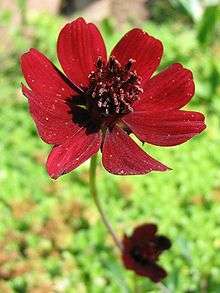
Cosmos atrosanguineus, the chocolate cosmos, is a species of Cosmos, native to Mexico, where it is extinct in the wild. The species was introduced into cultivation in 1902, where it survives as a single clone reproduced by vegetative propagation.[4]
Cosmos atrosanguineus is a herbaceous perennial plant growing to 40–60 cm tall, with a fleshy tuberous root. The leaves are 7–15 cm long, pinnate, with leaflets 2–5 cm long. The flowers are produced in a capitulum 3-4.5 cm diameter, dark red to maroon-dark brown, with a ring of six to ten (usually eight) broad ray florets and a center of disc florets; they have a light vanillin fragrance (like many chocolates), which becomes more noticeable as the summer day wears on.[5]
Cultivation and uses
The single surviving clone is a popular ornamental plant, grown for its rich dark red-brown flowers. It is not self-fertile, so no viable seeds are produced, and the plant has to be propagated by division of the tubers, or by tissue culture.[6]
It requires partial sun or full sun, and flowers from mid to late summer. It is frost-sensitive (Zones 6-11); in temperate zones, the tuber has to be dug up and stored in a frost-free store over the winter.
References
- ↑ The International Plant Names Index
- ↑ Tropicos
- ↑ The Plant List
- ↑ Encyclopedia of Life
- ↑
- ↑ Huxley, A. (ed.) 1992. New RHS Dictionary of Gardening 1: 739. Macmillan.