DDB2
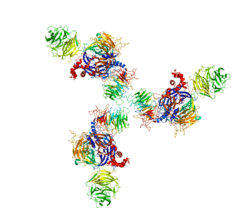
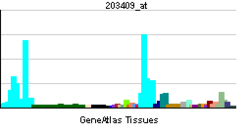
| View/Edit Human | View/Edit Mouse |
DNA damage-binding protein 2 is a protein that in humans is encoded by the DDB2 gene.[3][4]
Function
DDB2 is the smaller subunit of a heterodimeric protein implicated in the etiology of xeroderma pigmentosum group E. This subunit appears to be required for DNA binding.[5]
Interactions
DDB2 has been shown to interact with CUL4A,[6] CUL4B[6] and DDB1.[6][7][8] Also, some researches about DDB2 show a relationship between DDB2 and PARP1.PARP1 as a novel DDB2-associated factor,which may help to recruitment a chromatin-remodeling enzyme,named ALC1.[9]
References
- ↑ "Human PubMed Reference:".
- ↑ "Mouse PubMed Reference:".
- ↑ Keeney S, Chang GJ, Linn S (Oct 1993). "Characterization of a human DNA damage binding protein implicated in xeroderma pigmentosum E". The Journal of Biological Chemistry. 268 (28): 21293–300. PMID 8407967.
- ↑ Dualan R, Brody T, Keeney S, Nichols AF, Admon A, Linn S (Sep 1995). "Chromosomal localization and cDNA cloning of the genes (DDB1 and DDB2) for the p127 and p48 subunits of a human damage-specific DNA binding protein". Genomics. 29 (1): 62–9. doi:10.1006/geno.1995.1215. PMID 8530102.
- ↑ "Entrez Gene: DDB2 damage-specific DNA binding protein 2, 48kDa".
- 1 2 3 Guerrero-Santoro J, Kapetanaki MG, Hsieh CL, Gorbachinsky I, Levine AS, Rapić-Otrin V (Jul 2008). "The cullin 4B-based UV-damaged DNA-binding protein ligase binds to UV-damaged chromatin and ubiquitinates histone H2A". Cancer Research. 68 (13): 5014–22. doi:10.1158/0008-5472.CAN-07-6162. PMID 18593899.
- ↑ Bergametti F, Sitterlin D, Transy C (Jul 2002). "Turnover of hepatitis B virus X protein is regulated by damaged DNA-binding complex". Journal of Virology. 76 (13): 6495–501. doi:10.1128/JVI.76.13.6495-6501.2002. PMC 136256
 . PMID 12050362.
 - ↑ Martinez E, Palhan VB, Tjernberg A, Lymar ES, Gamper AM, Kundu TK, Chait BT, Roeder RG (Oct 2001). "Human STAGA complex is a chromatin-acetylating transcription coactivator that interacts with pre-mRNA splicing and DNA damage-binding factors in vivo". Molecular and Cellular Biology. 21 (20): 6782–95. doi:10.1128/MCB.21.20.6782-6795.2001. PMC 99856. PMID 11564863.
- ↑ Pines A, Vrouwe MG, Marteijn JA, Typas D, Luijsterburg MS, Cansoy M, Hensbergen P, Deelder A, de Groot A, Matsumoto S, Sugasawa K, Thoma N, Vermeulen W, Vrieling H, Mullenders L (Oct 2012). "PARP1 promotes nucleotide excision repair through DDB2 stabilization and recruitment of ALC1". The Journal of Cell Biology. 199 (2): 235–49. doi:10.1083/jcb.201112132. PMID 23045548.
Further reading
- El-Deiry WS (2003). "Transactivation of repair genes by BRCA1". Cancer Biology & Therapy. 1 (5): 490–1. doi:10.4161/cbt.1.5.162. PMID 12496474.
- Qian YW, Wang YC, Hollingsworth RE, Jones D, Ling N, Lee EY (Aug 1993). "A retinoblastoma-binding protein related to a negative regulator of Ras in yeast". Nature. 364 (6438): 648–52. doi:10.1038/364648a0. PMID 8350924.
- Taunton J, Hassig CA, Schreiber SL (Apr 1996). "A mammalian histone deacetylase related to the yeast transcriptional regulator Rpd3p". Science. 272 (5260): 408–11. doi:10.1126/science.272.5260.408. PMID 8602529.
- Nichols AF, Ong P, Linn S (Oct 1996). "Mutations specific to the xeroderma pigmentosum group E Ddb- phenotype". The Journal of Biological Chemistry. 271 (40): 24317–20. doi:10.1074/jbc.271.40.24317. PMID 8798680.
- Hayes S, Shiyanov P, Chen X, Raychaudhuri P (Jan 1998). "DDB, a putative DNA repair protein, can function as a transcriptional partner of E2F1". Molecular and Cellular Biology. 18 (1): 240–9. doi:10.1128/mcb.18.1.240. PMC 121483. PMID 9418871.
- Martinez E, Palhan VB, Tjernberg A, Lymar ES, Gamper AM, Kundu TK, Chait BT, Roeder RG (Oct 2001). "Human STAGA complex is a chromatin-acetylating transcription coactivator that interacts with pre-mRNA splicing and DNA damage-binding factors in vivo". Molecular and Cellular Biology. 21 (20): 6782–95. doi:10.1128/MCB.21.20.6782-6795.2001. PMC 99856. PMID 11564863.
- Chen X, Zhang Y, Douglas L, Zhou P (Dec 2001). "UV-damaged DNA-binding proteins are targets of CUL-4A-mediated ubiquitination and degradation". The Journal of Biological Chemistry. 276 (51): 48175–82. doi:10.1074/jbc.M106808200. PMID 11673459.
- Sun NK, Kamarajan P, Huang H, Chao CC (Feb 2002). "Restoration of UV sensitivity in UV-resistant HeLa cells by antisense-mediated depletion of damaged DNA-binding protein 2 (DDB2)". FEBS Letters. 512 (1-3): 168–72. doi:10.1016/S0014-5793(02)02250-0. PMID 11852074.
- Tan T, Chu G (May 2002). "p53 Binds and activates the xeroderma pigmentosum DDB2 gene in humans but not mice". Molecular and Cellular Biology. 22 (10): 3247–54. doi:10.1128/MCB.22.10.3247-3254.2002. PMC 133779. PMID 11971958.
- Rapić-Otrin V, McLenigan MP, Bisi DC, Gonzalez M, Levine AS (Jun 2002). "Sequential binding of UV DNA damage binding factor and degradation of the p48 subunit as early events after UV irradiation". Nucleic Acids Research. 30 (11): 2588–98. doi:10.1093/nar/30.11.2588. PMC 117178. PMID 12034848.
- Bergametti F, Sitterlin D, Transy C (Jul 2002). "Turnover of hepatitis B virus X protein is regulated by damaged DNA-binding complex". Journal of Virology. 76 (13): 6495–501. doi:10.1128/JVI.76.13.6495-6501.2002. PMC 136256. PMID 12050362.
- Bontron S, Lin-Marq N, Strubin M (Oct 2002). "Hepatitis B virus X protein associated with UV-DDB1 induces cell death in the nucleus and is functionally antagonized by UV-DDB2". The Journal of Biological Chemistry. 277 (41): 38847–54. doi:10.1074/jbc.M205722200. PMID 12151405.
- Sun NK, Lu HP, Chao CC (Nov 2002). "Overexpression of damaged-DNA-binding protein 2 (DDB2) potentiates UV resistance in hamster V79 cells". Chang Gung Medical Journal. 25 (11): 723–33. PMID 12553360.
- Groisman R, Polanowska J, Kuraoka I, Sawada J, Saijo M, Drapkin R, Kisselev AF, Tanaka K, Nakatani Y (May 2003). "The ubiquitin ligase activity in the DDB2 and CSA complexes is differentially regulated by the COP9 signalosome in response to DNA damage". Cell. 113 (3): 357–67. doi:10.1016/S0092-8674(03)00316-7. PMID 12732143.
- Rapić-Otrin V, Navazza V, Nardo T, Botta E, McLenigan M, Bisi DC, Levine AS, Stefanini M (Jul 2003). "True XP group E patients have a defective UV-damaged DNA binding protein complex and mutations in DDB2 which reveal the functional domains of its p48 product". Human Molecular Genetics. 12 (13): 1507–22. doi:10.1093/hmg/ddg174. PMID 12812979.
- Fitch ME, Nakajima S, Yasui A, Ford JM (Nov 2003). "In vivo recruitment of XPC to UV-induced cyclobutane pyrimidine dimers by the DDB2 gene product". The Journal of Biological Chemistry. 278 (47): 46906–10. doi:10.1074/jbc.M307254200. PMID 12944386.
External links
This article is issued from Wikipedia - version of the 5/20/2016. The text is available under the Creative Commons Attribution/Share Alike but additional terms may apply for the media files.