Damasonium minus
| Damasonium minus | |
|---|---|
 | |
| Scientific classification | |
| Kingdom: | Plantae |
| (unranked): | Angiosperms |
| (unranked): | Monocots |
| Order: | Alismatales |
| Family: | Alismataceae |
| Genus: | Damasonium |
| Species: | D. minus |
| Binomial name | |
| Damasonium minus (R.Br.) Buchenau[1] | |
| Synonyms[2] | |
|
Damasonium australe Salisb. (nom. illeg.) nom. superfl. | |
Damasonium minus is a species of flowering plant in the water-plantain family known by the common names starfruit and star-fruit (not to be confused with the cultivated starfruit).[1] It is native to Australia, where it occurs everywhere except the Northern Territory.[1][3] It is perhaps best known as an agricultural weed. It is a major weed of Australian rice crops.[4][5][6]
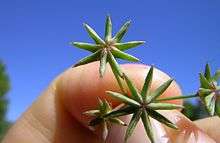
This species is an emergent aquatic plant. It is an annual or short-lived perennial herb growing up to a meter tall. The floating or emergent leaves have blades up to 10 centimeters long by 4 wide and lance-shaped to heart-shaped. They are borne on petioles up to 30 centimeters long. The branching inflorescence has whorls of flowers. Each flower has tiny green sepals and white or pink petals a few millimeters long. The star-shaped aggregate fruit is made up of follicles containing seeds.[3][7]
This plant grows in habitat with slow-moving and still water, such as swamps.[3]
In agriculture, this plant has been called "the most important broadleaf weed in the Australian rice crop."[5] Most rice is grown in Victoria and New South Wales.[5] This weed has been controlled with the herbicide bensulfuron-methyl, but it has become less effective as herbicide-resistant strains have evolved.[5] A pathogenic fungus, Rhynchosporium alismatis, was discovered on the plant, and it has become an option for biological control as a mycoherbicide. The fungus causes chlorosis and necrosis of the leaves on the mature plant and stunting of immature individuals. If immature weeds in a paddy are stunted, the rice plants may have a competitive advantage.[4] The fungus can kill seedlings, and if it infects the inflorescence of the weed it can reduce seed weight and viability.[8] The fungus can also help control another rice weed, Alisma lanceolatum.[6]
References
- 1 2 3 "Damasonium minus (R.Br.) Buchenau". Australian Plant Name Index (APNI), IBIS database. Centre for Plant Biodiversity Research, Australian Government. Retrieved 17 June 2013.
- ↑ "Damasonium%". Australian Plant Name Index (APNI), Integrated Botanical Information System (IBIS) database (listing by % wildcard matching of all taxa relevant to Australia). Centre for Plant Biodiversity Research, Australian Government. Retrieved 17 June 2013.
- 1 2 3 Damasonium minus. Threatened Flora of Tasmania.
- 1 2 Jahromi, F. G., et al. (2004). Factors affecting disease development by Rhynchosporium alismatis in starfruit (Damasonium minus), a weed of rice. Biocontrol Science and Technology 14(3) 281-290.
- 1 2 3 4 Jahromi, F. G., et al. (2002). Early infection process of Damasonium minus by the potential mycoherbistat Rhynchosporium alismatis. Canadian Journal of Plant Pathology 24(2) 131-38.
- 1 2 Cother, E. J. and R. L. Gilbert. (1994). Efficacy of a potential mycoherbicide for control of Alisma lanceolatum and Damasonium minus in Australian rice crops. Australian Journal of Experimental Agriculture 34 1043–50.
- ↑ Damasonium minus. New South Wales Flora Online. National Herbarium, Royal Botanic Garden, Sydney.
- ↑ Cother, E. J., et al. "Development of the mycoherbistat fungus Rhynchosporium alismatis for control of Alismataceae weeds in rice." In: Hill, J. E. and B. Hardy, Eds. Proceedings of the Second Temperate Rice Conference. June 13-17, 1999. Sacramento, California. pg. 509.