Darwinia virescens
| Murchison Darwinia | |
|---|---|
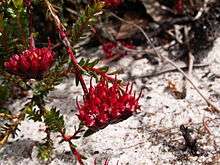 | |
| D.virescens in Lesueur National Park. | |
| Scientific classification | |
| Kingdom: | Plantae |
| (unranked): | Angiosperms |
| (unranked): | Eudicots |
| (unranked): | Rosids |
| Order: | Myrtales |
| Family: | Myrtaceae |
| Genus: | Darwinia |
| Species: | D. virescens |
| Binomial name | |
| Darwinia virescens (Meisn.) Benth.[1] | |
Darwinia virescens, commonly known as the Murchison Darwinia, is a plant in the myrtle family Myrtaceae and which is endemic to a small area on the west coast of Western Australia near Geraldton.
Description
Darwinia virescens grows as a small, prostrate shrub 5–30 cm (2–10 in) high. It has green, yellow and red flowers from August to January.[2]
Taxonomy and naming
It was first described in 1857 by Carl Meissner as Genetyllis virescens in Journal of the Proceedings of the Linnean Society, Botany[3][4] but in 1867, George Bentham included it in the genus Darwinia.[1][5] The specific epithet (virescens) is a Latin word meaning "growing green or verdant.[6]
Distribution and habitat
The Murchison Darwinia occurs in the Swan Coastal Plain and Geraldton Sandplains biogeographic regions of Western Australia growing in white or yellow sand in heath.[7]
Conservation status
Darwinia virescens is classified as not threatened.[7]
Ecology
The flowers of Darwinia virescens (and of Darwinia sanguinea) are held at ground level and there is speculation that this suggests that they are pollinated by mammals.[8]
References
- 1 2 "Darwinia virescens". APNI. Retrieved 28 February 2015.
- ↑ Paczkowska, Grazyna; Chapman, Alex R. (2000). The Western Australian flora : a descriptive catalogue. Perth: Wildflower Society of Western Australia. p. 361. ISBN 0646402439.
- ↑ "Genetyllis virescens". APNI. Retrieved 28 February 2015.
- ↑ Meissner, Carl (1857). "On some new species of Chamaelauciae". Journal of the proceedings of the Linnean Society, Botany. 1: 38. Retrieved 7 November 2016.
- ↑ Bentham, George (1865). "Note on the genera Darwinia, Rudge, and Bartlingia Ad.Brongn.". Journal of the proceedings of the Linnean Society, Botany. 9: 179. Retrieved 7 November 2016.
- ↑ Brown, Roland Wilbur (1956). The Composition of Scientific Words. Washington, D.C.: Smithsonian Institution Press. p. 383.
- 1 2 "Darwinia virescens (Meisn.) Benth.". FloraBase. Western Australian Government Department of Parks and Wildlife.
- ↑ Kubitzki, Klaus (ed.) (2010). The families and genera of vascular plants sapindales, cucurbitales, myrtaceae. Heidelberg: Springer. p. 219. ISBN 9783642143977. Retrieved 28 February 2015.