Descartes snark
| Descartes snark | |
|---|---|
|
Image of a Descartes snark. | |
| Named after | Blanche Descartes |
| Vertices | 210 |
| Edges | 315 |
| Girth | 5 |
| Chromatic index | 4 |
| Properties |
Cubic Snark |
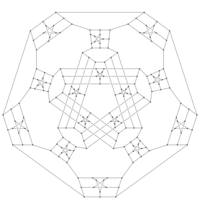
In the mathematical field of graph theory, a Descartes snark is an undirected graph with 210 vertices and 315 edges. It is a snark, first discovered by William Tutte in 1948 under the pseudonym Blanche Descartes.[1]
A Descartes snark is obtained from the Petersen graph by replacing each vertex with a nonagon and each edge with a particular graph closely related to the Petersen graph. Because there are multiple ways to perform this procedure, there are multiple Descartes snarks.
Notes
- ↑ Descartes, Blanche. "Network Colorings," The Mathematical Gazette (London, 32:299. p. 67–69, 1948.
This article is issued from Wikipedia - version of the 4/11/2016. The text is available under the Creative Commons Attribution/Share Alike but additional terms may apply for the media files.