Diagonal scale
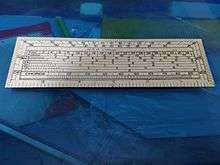
Diagonal scale is an engineering measuring instrument which is composed of a set of parallel straight lines which are obliquely crossed by another set of straight lines. Diagonal scales are used to measure small fractions of the unit of measurement.[1]
Etymology
Diagonal scale is derived from the Latin word Diagonalis. The Latin word was originally coined from the Greek word diagōnios where dia means "through" and gonios denotes "corners".[1][2]
Principle of Diagonal scale
Diagonal scale follows the principle of similar triangles where a short length is divided into number of parts in which sides are proportional.[3]
Application
Diagonal scale is used in engineering to read lengths with higher accuarcy as it represents a unit into three different multiple in metres, centimeters and millimeters.[4] Diagonal scale is an important part in Engineering drawings.[5]
References
- 1 2 Webster's Revised Unabridged Dictionary of the English Language: The Dictionary Proper Being the Authentic Ed. ... of 1890, to which is Now Added a Department of New Words Together with Many Valuable Special Features. Merriam-Webster. 1913.
- ↑ Davidson, Thomas (1907). Chambers's Twentieth Century Dictionary of the English Language. W. & R. Chambers Limited.
- ↑ "Types of Scales in Engineering Surveying | Civil Engineering Projects". 28 October 2011. Retrieved 26 September 2016.
- ↑ Khan, Md Zulfequar Ahmad. Text Book Of Practical Geography. Concept Publishing Company. p. 26. ISBN 9788170226826.
- ↑ Punmia, B. C. Surveying. Firewall Media. p. 11. ISBN 9788170088530. Retrieved 26 September 2016.