Diisopropylamine
 | |
| Names | |
|---|---|
| Preferred IUPAC name
N-(Propan-2-yl)propan-2-amine | |
| Other names
Di(propan-2-yl)amine N-Isopropylpropan-2-amine (Diisopropyl)amine (The name diisopropylamine is deprecated.) | |
| Identifiers | |
108-18-9  | |
| 3D model (Jmol) | Interactive image |
| Abbreviations | DIPA |
| 605284 | |
| ChemSpider | 7624 |
| ECHA InfoCard | 100.003.235 |
| EC Number | 203-558-5 |
| PubChem | 7912 |
| RTECS number | IM4025000 |
| UNII | BR9JLI40NO |
| UN number | 1158 |
| |
| |
| Properties | |
| C6H15N | |
| Molar mass | 101.19 g·mol−1 |
| Appearance | Colorless liquid |
| Odor | Fishy, ammoniacal |
| Density | 0.722 g mL−1 |
| Melting point | −61.00 °C; −77.80 °F; 212.15 K |
| Boiling point | 83 to 85 °C; 181 to 185 °F; 356 to 358 K |
| miscible[1] | |
| Vapor pressure | 6.7 kPa (at 20 °C) |
| Acidity (pKa) | 11.07 (in water) (conjugate acid) |
| Basicity (pKb) | 3.43[2] |
| Refractive index (nD) |
1.392–1.393 |
| Thermochemistry | |
| Std enthalpy of formation (ΔfH |
−173.6 to −168.4 kJ mol−1 |
| Std enthalpy of combustion (ΔcH |
−4.3363 to −4.3313 MJ mol−1 |
| Hazards | |
| GHS pictograms | 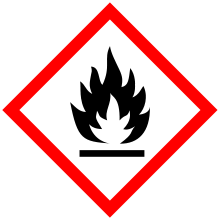 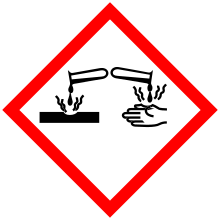  |
| GHS signal word | DANGER |
| H225, H302, H314, H332 | |
| P210, P280, P305+351+338, P310 | |
| EU classification (DSD) |
 F F  C C |
| R-phrases | R11, R20/22, R34 |
| S-phrases | (S1/2), S16, S26, S36/37/39 |
| NFPA 704 | |
| Flash point | −17 °C (1 °F; 256 K) |
| 315 °C (599 °F; 588 K) | |
| Explosive limits | 1.1–7.1%[1] |
| Lethal dose or concentration (LD, LC): | |
| LD50 (median dose) |
|
| LC50 (median concentration) |
1140 ppm (rat, 2 hr) 1000 ppm (mouse, 2 hr)[3] |
| LCLo (lowest published) |
2207 ppm (rabbit, 2.5 hr) 2207 ppm (guinea pig, 80 min) 2207 ppm (cat, 72 min)[3] |
| US health exposure limits (NIOSH): | |
| PEL (Permissible) |
TWA 5 ppm (20 mg/m3) [skin][1] |
| REL (Recommended) |
TWA 5 ppm (20 mg/m3) [skin][1] |
| IDLH (Immediate danger) |
200 ppm[1] |
| Related compounds | |
| Related amines |
|
| Related compounds |
|
| Except where otherwise noted, data are given for materials in their standard state (at 25 °C [77 °F], 100 kPa). | |
 verify (what is ?) verify (what is ?) | |
| Infobox references | |

Diisopropylamine is a secondary amine with the chemical formula (CH3)2HC-NH-CH(CH3)2. It is best known as its lithium derivative of its conjugate base, lithium diisopropylamide, known as "LDA". LDA is a strong, non-nucleophilic base.
Diisopropylamine can be dried by distillation from potassium hydroxide (KOH) or drying over sodium wire.[4]
Reactions and uses
Diisopropylamine is primarily used as a precursor to two herbicides, diallate and triallate, as well as certain sulfenamides used in the vulcanization of rubber.[5] It is also used to prepare N,N-Diisopropylethylamine (Hünig's base) by alkylation with diethyl sulfate.[6]
The bromide salt of diisopropylamine, diisopropylammonium bromide, is an organic molecular solid whose crystals are ferroelectric at room temperature.[7] This renders it a possible more biospherically inert alternative to barium titanate.
Preparation
Diisopropylamine is commercially available. It may be prepared by the reductive amination of acetone with ammonia using a modified copper oxide, generally copper chromite, as a catalyst:[8][9]
- NH
3 + 2(CH
3)
2CO + 2H
2 → C
6H
15N + 2H
2O
References
- 1 2 3 4 5 "NIOSH Pocket Guide to Chemical Hazards #0217". National Institute for Occupational Safety and Health (NIOSH).
- ↑ "DIISOPROPYLAMINE". pub chem. NIH. Retrieved 20 October 2015.
- 1 2 "Diisopropylamine". Immediately Dangerous to Life and Health. National Institute for Occupational Safety and Health (NIOSH).
- ↑ Armarego, W. L. F. and Perrin, D. D. Purification of Laboratory Chemicals 4th Ed. pg 186, Butterworth and Heinemann: Boston, 1996.
- ↑ Karsten Eller, Erhard Henkes, Roland Rossbacher, Hartmut Höke "Amines, Aliphatic" Ullmann's Encyclopedia of Industrial Chemistry, 2000, Wiley-VCH, Weinheim. doi:10.1002/14356007.a02_001
- ↑ Hünig, S.; Kiessel, M. (1958). "Spezifische Protonenacceptoren als Hilfsbasen bei Alkylierungs- und Dehydrohalogenierungsreaktionen". Chemische Berichte. 91 (2): 380–392. doi:10.1002/cber.19580910223.
- ↑ "An organic alternative to oxides? Organic ferroelectric molecule shows promise for memory chips, sensors". phys.org. Jan 24, 2013.
- ↑ Karl Löffler. "Über eine neue Bildungsweise primärer und sekundärer Amine aus Ketonen". Berichte. 43 (2): 2031–2035. doi:10.1002/cber.191004302145.
- ↑ US 2686811, Willard Bull, "One-step process for preparing diisopropylamine"