Direct sum of topological groups
In mathematics, a topological group G is called the topological direct sum[1] of two subgroups H1 and H2 if the map
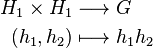
is a topological isomorphism.
More generally, G is called the direct sum of a finite set of subgroups  of the map
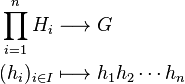
Note that if a topological group G is the topological direct sum of the family of subgroups  then in particular, as an abstract group (without topology) it is also the direct sum (in the usual way) of the family .
Topological direct summands
Given a topological group G, we say that a subgroup H is a topological direct summand of G (or that splits topologically form G ) if and only if there exist another subgroup K ≤ G such that G is the direct sum of the subgroups H and K.
A the subgroup H is a topological direct summand if and only if the extension of topological groups

splits, where  is the natural inclusion and
  is the natural projection.
Examples
- Suppose that
 is a locally compact abelian group that contains the unit circle
  as a subgroup. Then is a topological direct summand of G. The same assertion is true for the real numbers
  [2]
[2]
References
- ↑ E. Hewitt and K. A. Ross, Abstract harmonic analysis. Vol. I, second edition, Grundlehren der Mathematischen Wissenschaften, 115, Springer, Berlin, 1979. MR0551496 (81k:43001)
- ↑ Armacost, David L. The structure of locally compact abelian groups. Monographs and Textbooks in Pure and Applied Mathematics, 68. Marcel Dekker, Inc., New York, 1981. vii+154 pp. ISBN 0-8247-1507-1 MR0637201 (83h:22010)