Duricrust
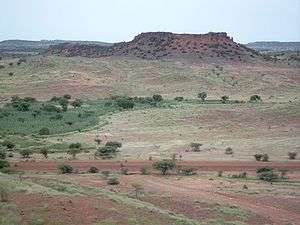
Duricrust is a hard layer on or near the surface of soil. Duricrusts can range in thickness from a few millimeters or centimeters to several meters.
It is a general term (not to be confused with duripan) for a zone of chemical precipitation and hardening formed at or near the surface of sedimentary bodies through pedogenic and (or) non-pedogenic processes. It is typically formed by the accumulation of soluble minerals deposited by mineral-bearing waters that move upward, downward, or laterally by capillary action, commonly assisted in arid settings by evaporation.[1][2][3] Minerals often found in duricrust include silica, iron, calcium, and gypsum.
Duricrusts need to be formed in absolute accumulation, therefore they must have a source, transfer and precipitation. Duricrust is often studied during missions to Mars because it may help prove the planet once had more water. Duricrust was found on Mars at the Viking 2 landing site, and a similar structure, nicknamed "Snow Queen," was found under the Phoenix landing site.[4] Phoenix's duricrust was later confirmed to be water-based.[5]
See also
References
- ↑ Dixon, 1994
- ↑ Woolnough, 1930
- ↑ NADMSC SLTT, 2004
- ↑ Rayl, A.J.S. (June 1, 2008). "Holy Cow, Snow Queen! Phoenix Landed on Ice, Team Thinks". The Planetary Society. Retrieved November 12, 2008.
- ↑ Nemiroff, R.; Bonnell, J., eds. (November 12, 2008). "Phoenix and the Holy Cow". Astronomy Picture of the Day. NASA. Retrieved November 12, 2008.
Further reading
- DILL, H.G., WEBER, B. and BOTZ, R. (2013) Metalliferous duricrusts (“orecretes”) - markers of weathering: A mineralogical and climatic-geomorphological approach to supergene Pb-Zn-Cu-Sb-P mineralization on different parent materials.- Neues Jahrbuch für Mineralogie Abhandlungen, 190: 123-195