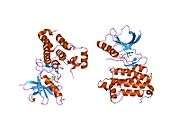
EPH receptor A2
| View/Edit Human | View/Edit Mouse |
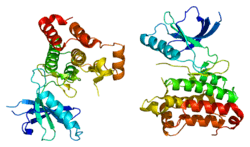
EPH receptor A2 (ephrin type-A receptor 2) is a protein that in humans is encoded by the EPHA2 gene.[3][4]
Function
This gene belongs to the ephrin receptor subfamily of the protein-tyrosine kinase family. EPH and EPH-related receptors have been implicated in mediating developmental events, particularly in the nervous system. Receptors in the EPH subfamily typically have a single kinase domain and an extracellular region containing a Cys-rich domain and 2 fibronectin type III repeats. The ephrin receptors are divided into 2 groups based on the similarity of their extracellular domain sequences and their affinities for binding ephrin-A and ephrin-B ligands. This gene encodes a protein that binds ephrin-A ligands.[4]
Clinical significance
It may be implicated in BRAF mutated melanomas becoming resistant to BRAF-inhibitors and MEK inhibitors.[5] It also the receptor by which Kaposi sarcoma-associated herpesvirus (KSHV) enters host cells and small molecule inhibitors of EphA2 have shown some ability to block KSHV entry into human cells.[6]
Interactions
EPH receptor A2 has been shown to interact with:
References
- ↑ "Human PubMed Reference:".
- ↑ "Mouse PubMed Reference:".
- ↑ Sulman EP, Tang XX, Allen C, Biegel JA, Pleasure DE, Brodeur GM, Ikegaki N (April 1997). "ECK, a human EPH-related gene, maps to 1p36.1, a common region of alteration in human cancers". Genomics. 40 (2): 371–4. doi:10.1006/geno.1996.4569. PMID 9119409.
- 1 2 "Entrez Gene: EPHA2 EPH receptor A2".
- ↑ "Counteracting Drug Resistance in Melanoma". 2015.
- ↑ Hahn AS, Kaufmann JK, Wies E, Naschberger E, Panteleev-Ivlev J, Schmidt K, Holzer A, Schmidt M, Chen J, König S, Ensser A, Myoung J, Brockmeyer NH, Stürzl M, Fleckenstein B, Neipel F (2012). "The ephrin receptor tyrosine kinase A2 is a cellular receptor for Kaposi's sarcoma–associated herpesvirus". Nat. Med. 18 (6): 961–6. doi:10.1038/nm.2805. PMC 3645317
 . PMID 22635007.
 - ↑ Kikawa KD, Vidale DR, Van Etten RL, Kinch MS (October 2002). "Regulation of the EphA2 kinase by the low molecular weight tyrosine phosphatase induces transformation". J. Biol. Chem. 277 (42): 39274–9. doi:10.1074/jbc.M207127200. PMID 12167657.
- 1 2 Pratt RL, Kinch MS (October 2002). "Activation of the EphA2 tyrosine kinase stimulates the MAP/ERK kinase signaling cascade". Oncogene. 21 (50): 7690–9. doi:10.1038/sj.onc.1205758. PMID 12400011.
- ↑ Pandey A, Lazar DF, Saltiel AR, Dixit VM (December 1994). "Activation of the Eck receptor protein tyrosine kinase stimulates phosphatidylinositol 3-kinase activity". J. Biol. Chem. 269 (48): 30154–7. PMID 7982920.
Further reading
- Flanagan JG, Vanderhaeghen P (1998). "The ephrins and Eph receptors in neural development". Annu. Rev. Neurosci. 21: 309–45. doi:10.1146/annurev.neuro.21.1.309. PMID 9530499.
- Zhou R (1998). "The Eph family receptors and ligands". Pharmacol. Ther. 77 (3): 151–81. doi:10.1016/S0163-7258(97)00112-5. PMID 9576626.
- Holder N, Klein R (1999). "Eph receptors and ephrins: effectors of morphogenesis". Development. 126 (10): 2033–44. PMID 10207129.
- Wilkinson DG (2000). "Eph receptors and ephrins: regulators of guidance and assembly". Int. Rev. Cytol. 196: 177–244. doi:10.1016/S0074-7696(00)96005-4. PMID 10730216.
- Xu Q, Mellitzer G, Wilkinson DG (2000). "Roles of Eph receptors and ephrins in segmental patterning". Philos. Trans. R. Soc. Lond., B, Biol. Sci. 355 (1399): 993–1002. doi:10.1098/rstb.2000.0635. PMC 1692797. PMID 11128993.
- Wilkinson DG (2001). "Multiple roles of EPH receptors and ephrins in neural development". Nat. Rev. Neurosci. 2 (3): 155–64. doi:10.1038/35058515. PMID 11256076.
- Kinch MS, Carles-Kinch K (2003). "Overexpression and functional alterations of the EphA2 tyrosine kinase in cancer". Clin. Exp. Metastasis. 20 (1): 59–68. doi:10.1023/A:1022546620495. PMID 12650608.
- Walker-Daniels J, Hess AR, Hendrix MJ, Kinch MS (2003). "Differential regulation of EphA2 in normal and malignant cells". Am. J. Pathol. 162 (4): 1037–42. doi:10.1016/S0002-9440(10)63899-0. PMC 1851246. PMID 12651595.
- Lindberg RA, Hunter T (1990). "cDNA cloning and characterization of eck, an epithelial cell receptor protein-tyrosine kinase in the eph/elk family of protein kinases". Mol. Cell. Biol. 10 (12): 6316–24. PMC 362907. PMID 2174105.
- Pandey A, Shao H, Marks RM, Polverini PJ, Dixit VM (1995). "Role of B61, the ligand for the Eck receptor tyrosine kinase, in TNF-alpha-induced angiogenesis". Science. 268 (5210): 567–9. doi:10.1126/science.7536959. PMID 7536959.
- Pandey A, Duan H, Dixit VM (1995). "Characterization of a novel Src-like adapter protein that associates with the Eck receptor tyrosine kinase". J. Biol. Chem. 270 (33): 19201–4. doi:10.1074/jbc.270.33.19201. PMID 7543898.
- Ruiz JC, Robertson EJ (1994). "The expression of the receptor-protein tyrosine kinase gene, eck, is highly restricted during early mouse development". Mech. Dev. 46 (2): 87–100. doi:10.1016/0925-4773(94)90078-7. PMID 7918100.
- Davis S, Gale NW, Aldrich TH, Maisonpierre PC, Lhotak V, Pawson T, Goldfarb M, Yancopoulos GD (1994). "Ligands for EPH-related receptor tyrosine kinases that require membrane attachment or clustering for activity". Science. 266 (5186): 816–9. doi:10.1126/science.7973638. PMID 7973638.
- Pandey A, Lazar DF, Saltiel AR, Dixit VM (1994). "Activation of the Eck receptor protein tyrosine kinase stimulates phosphatidylinositol 3-kinase activity". J. Biol. Chem. 269 (48): 30154–7. PMID 7982920.
- Ganju P, Shigemoto K, Brennan J, Entwistle A, Reith AD (1994). "The Eck receptor tyrosine kinase is implicated in pattern formation during gastrulation, hindbrain segmentation and limb development". Oncogene. 9 (6): 1613–24. PMID 8183555.
- Gale NW, Holland SJ, Valenzuela DM, Flenniken A, Pan L, Ryan TE, Henkemeyer M, Strebhardt K, Hirai H, Wilkinson DG, Pawson T, Davis S, Yancopoulos GD (1996). "Eph receptors and ligands comprise two major specificity subclasses and are reciprocally compartmentalized during embryogenesis". Neuron. 17 (1): 9–19. doi:10.1016/S0896-6273(00)80276-7. PMID 8755474.
- Kozlosky CJ, VandenBos T, Park L, Cerretti DP, Carpenter MK (1997). "LERK-7: a ligand of the Eph-related kinases is developmentally regulated in the brain". Cytokine. 9 (8): 540–9. doi:10.1006/cyto.1997.0199. PMID 9245480.
- Ephnomenclaturecommittee (1997). "Unified nomenclature for Eph family receptors and their ligands, the ephrins. Eph Nomenclature Committee". Cell. 90 (3): 403–4. doi:10.1016/S0092-8674(00)80500-0. PMID 9267020.
PDB gallery | ||||
|---|---|---|---|---|
| ||||