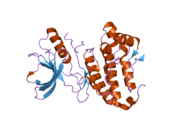
EPH receptor A3
| View/Edit Human | View/Edit Mouse |
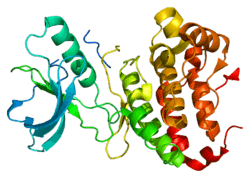
EPH receptor A3 (ephrin type-A receptor 3) is a protein that in humans is encoded by the EPHA3 gene.[3][4][5]
Function
This gene belongs to the ephrin receptor subfamily of the protein-tyrosine kinase family. EPH and EPH-related receptors have been implicated in mediating developmental events, particularly in the nervous system. Receptors in the EPH subfamily typically have a single kinase domain and an extracellular region containing a Cys-rich domain and 2 fibronectin type III repeats. The ephrin receptors are divided into 2 groups based on the similarity of their extracellular domain sequences and their affinities for binding ephrin-A and ephrin-B ligands. This gene encodes a protein that binds ephrin-A ligands. Two alternatively spliced transcript variants have been described for this gene.[5]
Interactions
EPH receptor A3 has been shown to interact with EFNB2[6][7] and EFNA5.[7][8]
References
- ↑ "Human PubMed Reference:".
- ↑ "Mouse PubMed Reference:".
- ↑ Boyd AW, Ward LD, Wicks IP, Simpson RJ, Salvaris E, Wilks A, Welch K, Loudovaris M, Rockman S, Busmanis I (March 1992). "Isolation and characterization of a novel receptor-type protein tyrosine kinase (hek) from a human pre-B cell line". J Biol Chem. 267 (5): 3262–7. PMID 1737782.
- ↑ Wicks IP, Wilkinson D, Salvaris E, Boyd AW (April 1992). "Molecular cloning of HEK, the gene encoding a receptor tyrosine kinase expressed by human lymphoid tumor cell lines". Proc Natl Acad Sci U S A. 89 (5): 1611–5. doi:10.1073/pnas.89.5.1611. PMC 48502
 . PMID 1311845.
 - 1 2 "Entrez Gene: EPHA3 EPH receptor A3".
- ↑ Cerretti DP, Vanden Bos T, Nelson N, Kozlosky CJ, Reddy P, Maraskovsky E, Park LS, Lyman SD, Copeland NG, Gilbert DJ (November 1995). "Isolation of LERK-5: a ligand of the eph-related receptor tyrosine kinases". Mol. Immunol. 32 (16): 1197–205. doi:10.1016/0161-5890(95)00108-5. PMID 8559144.
- 1 2 Lackmann M, Mann RJ, Kravets L, Smith FM, Bucci TA, Maxwell KF, Howlett GJ, Olsson JE, Vanden Bos T, Cerretti DP, Boyd AW (June 1997). "Ligand for EPH-related kinase (LERK) 7 is the preferred high affinity ligand for the HEK receptor". J. Biol. Chem. 272 (26): 16521–30. doi:10.1074/jbc.272.26.16521. PMID 9195962.
- ↑ Kozlosky CJ, VandenBos T, Park L, Cerretti DP, Carpenter MK (August 1997). "LERK-7: a ligand of the Eph-related kinases is developmentally regulated in the brain". Cytokine. 9 (8): 540–9. doi:10.1006/cyto.1997.0199. PMID 9245480.
Further reading
- Flanagan JG, Vanderhaeghen P (1998). "The ephrins and Eph receptors in neural development.". Annu. Rev. Neurosci. 21: 309–45. doi:10.1146/annurev.neuro.21.1.309. PMID 9530499.
- Zhou R (1998). "The Eph family receptors and ligands.". Pharmacol. Ther. 77 (3): 151–81. doi:10.1016/S0163-7258(97)00112-5. PMID 9576626.
- Ernst AF, Jurney WM, McLoon SC (1999). "Mechanisms involved in development of retinotectal connections: roles of Eph receptor tyrosine kinases, NMDA receptors and nitric oxide.". Prog. Brain Res. 118: 115–31. doi:10.1016/S0079-6123(08)63204-5. PMID 9932438.
- Holder N, Klein R (1999). "Eph receptors and ephrins: effectors of morphogenesis.". Development. 126 (10): 2033–44. PMID 10207129.
- Wilkinson DG (2000). "Eph receptors and ephrins: regulators of guidance and assembly.". Int. Rev. Cytol. 196: 177–244. doi:10.1016/S0074-7696(00)96005-4. PMID 10730216.
- Xu Q, Mellitzer G, Wilkinson DG (2001). "Roles of Eph receptors and ephrins in segmental patterning.". Philos. Trans. R. Soc. Lond., B, Biol. Sci. 355 (1399): 993–1002. doi:10.1098/rstb.2000.0635. PMC 1692797. PMID 11128993.
- Wilkinson DG (2001). "Multiple roles of EPH receptors and ephrins in neural development.". Nat. Rev. Neurosci. 2 (3): 155–64. doi:10.1038/35058515. PMID 11256076.
- Beckmann MP, Cerretti DP, Baum P, Vanden Bos T, James L, Farrah T, Kozlosky C, Hollingsworth T, Shilling H, Maraskovsky E (1994). "Molecular characterization of a family of ligands for eph-related tyrosine kinase receptors.". EMBO J. 13 (16): 3757–62. PMC 395287. PMID 8070404.
- Wicks IP, Lapsys NM, Baker E, Campbell LJ, Boyd AW, Sutherland GR (1994). "Localization of a human receptor tyrosine kinase (ETK1) to chromosome region 3p11.2.". Genomics. 19 (1): 38–41. doi:10.1006/geno.1994.1009. PMID 8188238.
- Cerretti DP, Vanden Bos T, Nelson N, Kozlosky CJ, Reddy P, Maraskovsky E, Park LS, Lyman SD, Copeland NG, Gilbert DJ (1996). "Isolation of LERK-5: a ligand of the eph-related receptor tyrosine kinases.". Mol. Immunol. 32 (16): 1197–205. doi:10.1016/0161-5890(95)00108-5. PMID 8559144.
- Lackmann M, Mann RJ, Kravets L, Smith FM, Bucci TA, Maxwell KF, Howlett GJ, Olsson JE, Vanden Bos T, Cerretti DP, Boyd AW (1997). "Ligand for EPH-related kinase (LERK) 7 is the preferred high affinity ligand for the HEK receptor.". J. Biol. Chem. 272 (26): 16521–30. doi:10.1074/jbc.272.26.16521. PMID 9195962.
- Kozlosky CJ, VandenBos T, Park L, Cerretti DP, Carpenter MK (1997). "LERK-7: a ligand of the Eph-related kinases is developmentally regulated in the brain.". Cytokine. 9 (8): 540–9. doi:10.1006/cyto.1997.0199. PMID 9245480.
- Ephnomenclaturecommittee (1997). "Unified nomenclature for Eph family receptors and their ligands, the ephrins. Eph Nomenclature Committee.". Cell. 90 (3): 403–4. doi:10.1016/S0092-8674(00)80500-0. PMID 9267020.
- Lackmann M, Oates AC, Dottori M, Smith FM, Do C, Power M, Kravets L, Boyd AW (1998). "Distinct subdomains of the EphA3 receptor mediate ligand binding and receptor dimerization.". J. Biol. Chem. 273 (32): 20228–37. doi:10.1074/jbc.273.32.20228. PMID 9685371.
- Ciossek T, Monschau B, Kremoser C, Löschinger J, Lang S, Müller BK, Bonhoeffer F, Drescher U (1998). "Eph receptor-ligand interactions are necessary for guidance of retinal ganglion cell axons in vitro.". Eur. J. Neurosci. 10 (5): 1574–80. doi:10.1046/j.1460-9568.1998.00180.x. PMID 9751130.
PDB gallery | ||||
|---|---|---|---|---|
| ||||