Echeveria runyonii
| Echeveria runyonii | |
|---|---|
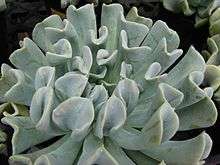 | |
| E. runyonii 'Topsy Turvy' | |
| Scientific classification | |
| Kingdom: | Plantae |
| (unranked): | Angiosperms |
| (unranked): | Eudicots |
| (unranked): | Core eudicots |
| Order: | Saxifragales |
| Family: | Crassulaceae |
| Genus: | Echeveria |
| Series: | Pruinosae[1] |
| Species: | E. runyonii |
| Binomial name | |
| Echeveria runyonii Rose ex E.Walther.[2] | |
Echeveria runyonii is a species of flowering plant in the sedum family, Crassulaceae,[2] that is native to the state of Tamaulipas in Mexico.[3] Several cultivars have been described and cultivated.
Taxonomy
Joseph Nelson Rose described Echeveria runyonii in 1935,[2] named in honour of Texas amateur botanist Robert Runyon.[4] Runyon had collected the type specimen from a Matamoros, Tamaulipas garden[5] in 1922.[6][7] Wild populations were unknown until 1990, when one was discovered by the staff of Yucca Do Nursery.[8]
The cytology of Echeveria species is helpful in identification, as many species can be very variable in appearance; E. runyoni has 14 chromosomes.[2]
Description
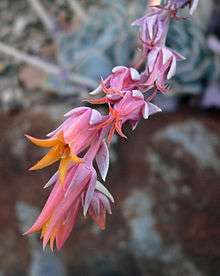
Echeveria runyonii forms a rosette 8–10 cm (3.1–3.9 in) in diameter. Leaves are spatulate-cuneate to oblong-spatulate, truncate to acuminate, and mucronate. They are a glaucous pinkish-white in color and measure 6–8 by 2.5–4 cm (2.4–3.1 by 1.0–1.6 in). The single stem reaches 10 cm (3.9 in) in length or more and a diameter of roughly 1 cm (0.39 in). Inflorescences are 15–20 cm (5.9–7.9 in) tall and have 2 – 3 cincinni, conspicuous bracts, and pedicels approximately 4 mm long. The red flowers have ascending-spreading sepals to 11 mm and pentagonal corollas measuring 19 – 20 × 10 mm.[2]
Echeveria peacockii has similar-coloured glaucous leaves, but its leaves are wedge-shaped with mucronulate (pointed) tips.[9]
Cultivation
Several named cultivars exist, including 'Texas Rose', 'Dr. Butterfield', 'Lucita', 'Tom Allen', and 'Topsy Turvy'. The last is a mutant form, which originated in California, in which the leaves are positioned upside-down.[1]
Hybrids
- Echeveria 'Domingo' (E. cante × E. runyonii)[10]
- Echeveria 'Green Star' (E. harmsii × E. runyonii 'Topsy Turvy')[11]
- Echeveria 'Swan Lake' (E. shaviana × E. runyonii 'Topsy Turvy')[12]
- Echeveria 'Glade Surprise' (E. derenbergii × E. runyonii 'Topsy Turvy')[13]
- Echeveria 'Dagda' (E. pulvinata 'Frosty' × E. runyonii 'Topsy Turvy')[14]
- Echeveria 'Exotic' (E. laui × E. runyonii 'Topsy Turvy')[15]
References
 |
Wikimedia Commons has media related to Echeveria runyonii. |
 |
Wikispecies has information related to: Echeveria runyonii |
- 1 2 "RUNYONII Rose ex Walther, 1935.". International Crassulaceae Network. Retrieved 2012-07-01.
- 1 2 3 4 5 Kimnach, Myron (2003). Urs Eggli, ed. Illustrated Handbook of Succulent Plants. Volume 6: Crassulaceae. Birkhäuser. pp. 103, 122. ISBN 9783540419655.
- ↑ Kimnach, Myron (January 2001). "Three varieties of Echeveria cuspidata". Cactus and Succulent Journal. 77 (1): 28–33.
- ↑ Eggli, Urs; Newton, Leonard E. (2004). Etymological Dictionary of Succulent Plant Names. Birkhäuser. p. 207. ISBN 3540004890.
- ↑ Scheick, William (July–August 2012). "Echeverian Beauty among the Rocks". Texas Gardener.
- ↑ "Isotype of Echeveria runyonii Rose, J.N. 1935 [family CRASSULACEAE]". JSTOR Plant Science. JSTOR. 2011-05-25. Retrieved 2012-07-01.
- ↑ "Echeveria runyonii Rose ex E. Walther". Collections Search Center. Smithonian Institute. Retrieved 2012-07-01.
- ↑ Finkel, Marty (October 2010). "Plant of the month Echeveria 'Topsy Turvy'" (PDF). The Garden Path.
- ↑ Cactus and Succulent Society of America (1998). Haseltonia: yearbook of the Cactus and Succulent Society of America, Issues 6-10. p. 81.
- ↑ "Domingo". International Crassulaceae Network. Retrieved 2012-07-01.
- ↑ "Green Star". International Crassulaceae Network. Retrieved 2012-07-01.
- ↑ "Swan Lake". International Crassulaceae Network. Retrieved 2012-07-01.
- ↑ "Glade Surprise". International Crassulaceae Network. Retrieved 2012-07-01.
- ↑ "Dagda". International Crassulaceae Network. Retrieved 2012-07-01.
- ↑ "Exotic". International Crassulaceae Network. Retrieved 2012-07-01.