Elisabeth Langgässer
| Elisabeth Langgässer | |
|---|---|
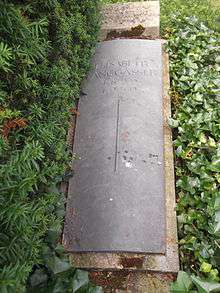 Tomb of Langgässer in the "Alter Friedhof" in Darmstadt | |
| Born |
23 February 1899 Alzey, Hesse, Germany |
| Died |
25 July 1950 (aged 51) Karlsruhe, West Germany |
| Nationality | German |
| Occupation | Writer |
| Partner(s) | Hermann Heller |
| Children | Cordelia Heller (b. 1929) |
Elisabeth Langgässer (23 February 1899 – 25 July 1950) was a German author and teacher. She is known for lyrical poetry and novels. Her short story Saisonbeginn, for example, provides a graphically human portrayal of a 1930s German Alpine village erecting a sign forbidding the entry of Jews.
Langgässer was born in Alzey. In the last free federal elections in March 1933 Langgässer voted for Adolf Hitler,[1] but then during the Third Reich she was considered a "half-Jew" and therefore expelled from the Reichsschrifttumskammer (writer's union) in 1936.
Langgässer's daughter with a married Jewish man Hermann Heller, Cordelia, spent the war years in Auschwitz after her mother's attempt to improve her racial status by marrying her to a Catholic army officer from Spain failed. Told that a confession would save her mother from prosecution, the 12-year-old Cordelia willingly went to live in a ghetto hospital. After surviving the Holocaust, she joined her mother in Sweden. Langgässer had been deemed "non-Aryan" (her father had converted from Judaism), but had subsequently upgraded her status to "German" by marrying a German with SS connections. Cordelia resisted the pressure from her mother to provide material for a death camp memoir, and married and had several children with a Swedish Protestant, becoming Cordelia Edvardson; quite unexpectedly, she emigrated to Israel at the height of the Yom Kippur War in 1973 and wrote a searing autobiography, Burnt Child Seeks the Fire.[2] Elisabeth Langgässer became a noted Catholic author. As such she was an influence on Pope Benedict XVI in his early years.
Langgässer died in Karlsruhe.