Enyo (software)
| Developer(s) | LG |
|---|---|
| Initial release | February 9, 2011 |
| Stable release |
2.7.0
/ April 1, 2016 |
| Development status | Active |
| Written in | Object-oriented programming |
| Operating system | Cross-platform |
| Type | JavaScript framework |
| License | Apache License 2.0 |
| Website |
enyojs |
Enyo is an open source JavaScript framework for cross-platform mobile, desktop, TV and web applications emphasizing object-oriented encapsulation and modularity.[1] Initially developed by Palm, which was later acquired by Hewlett-Packard and then released under an Apache 2.0 license.[2] Sponsored by LG Electronics and Hewlett-Packard.
Bootplate
Bootplate is a simplified way of creating an app, providing a skeleton of the program's folder tree. The Bootplate template provides a complete starter project that supports source control and cross-platform deployment out of the box. It can be used to facilitate both the creation of a new project and the preparation for its eventual deployment.[3]
Libraries
- Layout: Fittables, scrollers, lists, drawers, panels.
- Onyx: Based on the original styled of webOS/Touchpad design but available for use on any platform.
- Moonstone: Used by LG SmartTV apps but available for use on any platform.
- Spotlight: To support key-based interactions and "point and click" events on remote controls and keyboards.
- Mochi:[4] Advanced user interface library.It has been maintained by the community since the team behind webOS released this abandoned interface from Palm/HP as open source.[5] This library is not included on bootplate right now, but has very good design documents.[6]
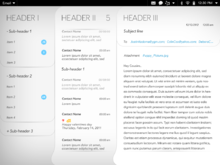 Enyo Mochi UI
 - enyo-iLib: Internationalization and localization library, it wrap ilib's functionality on Enyo apps.[7] G11n was another library that has been deprecated on newer versions of enyo.
- Canvas
- Extra
- enyo-cordova: Enyo-compatible library to automatically include platform-specific Cordova library (WIP).
Use
The following projects are built with Enyo:
- LG Smart TV apps.[8][9]
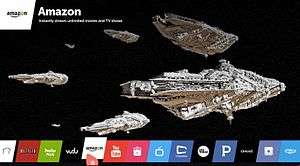 Screenshot of LG WebOS.
 - Openbravo Mobile and Web POS.[10]
- xTuple ERP Web and Mobile App.[11]
Partial list of Enyo apps can be found on Enyo Apps. Some developers can be found on Enyo Developer Directory.
Examples
This is an example of a 'Hello world program' in Enyo
enyo.kind({
  name: "HelloWorld",
  kind: enyo.Control,
  content: 'Hello, World!',
});

new HelloWorld().write();
Supported Platforms
In general, Enyo can run across all relatively modern, standards-based web environments, but because of the variety of them there are three priority tiers. At 2015[12] some platforms supported are:
- Tier 1 Supported at high priority:
Packaged Apps: iOS7, iOS6 (PhoneGap), Android 4+ (PhoneGap), Windows 8.1 Store App and Windows Phone 8 (PhoneGap), Blackberry 10 (PhoneGap), Chrome Web Store App, LG webOS.
Desktop Browsers: Chrome (latest), Safari (latest MAC), Firefox (latest), IE11 IE10, IE9, IE8. (Win).
Mobile Browsers: iOS7, iOS6, Android 4+ Chrome, Kindle Fire and HD, Blackberry 10, IE11 (Windows 8.1),IE10 (Windows Phone 8).
- Tier 2 Supported
Packaged Apps: iOS5, iOS4, Android 2.3,Firefox OS (pre-release), Tizen OS (pre-release), Windows 8 Store App, Windows (Intel AppUp).
Desktop Browsers: Opera, Chrome >10, Firefox >4, Safari >5.
Mobile Browsers: iOS5, iOS4, Android 4+ Firefox, webOS 3.0.5, webOS 2.2, BlackBerry 6-7, BlackBerry Playbook and others.
- Tier 3 Partial support
Mobile Browsers: Windows Phone 7.5.
- No support
Desktop Browsers: IE8
Mobile Browsers: Windows Phone 7, BlackBerry 6, Symbian, Opera Mini
Versions
|
Release date |
Version number |
Notes |
|---|---|---|
| 9 February 2011 | 1.0 (HP)[13] |
|
| January, 2012 | 1.0 (Open Source) | HP open sources Enyo under the Apache 2.0 license |
| 25 January 2012 | 2.0b |
|
| July 18, 2012 | 2.0 | Enyo 2 production version |
| August 30, 2012 | 2.0.1 | |
| October 26, 2012 | 2.1 |
|
| November 28, 2012 | 2.1.1 | Kindle Fire HD and IE 10 (for Windows 8,RT and Phone) support |
| February 21, 2013 | 2.2 |
|
| October 18, 2013 | 2.3.0-pre.10[14] |
|
| February 5, 2014 | 2.4.0-pre.1[15] | Focus for the cross-platform Enyo community (more than 2.3). |
| December 11, 2014 | 2.5.1.1[16] |
|
See also
References
- ↑ "Developing Enyo Applications". Retrieved 2011-12-30.
- ↑ "HP: WebOS, Enyo app framework goes open source". Retrieved 2011-12-30.
- ↑ "Bootplate Github". Retrieved 2012-07-24.
- ↑ "GitHub enyojs/mochi". Retrieved 6 April 2014.
- ↑ "Releasing Mochi". Retrieved 6 April 2014.
- ↑ "Mochi Designs". Retrieved 6 April 2014.
- ↑ "Localization". Retrieved 6 April 2014.
- ↑ http://ces2014.lgnewsroom.com/lg-makes-smart-tv-simple-new-webos-smart-tv-platform/. Retrieved 2014-02-07. Missing or empty
|title=(help) - ↑ "LG Electronics Acquires webOS from HP to Enhance Smart TV". Retrieved 2013-09-08.
- ↑ "Openbravo Mobile: Technical Overview and Roadmap".
- ↑ "A Shorter Letter". Retrieved 2014-03-22.
- ↑ "Supported Platforms". Retrieved 2015-09-25.
- ↑ "webOS Enyo framework free to developers today, brings pixel density agnostic apps to phones, tablets and PC". Retrieved 2013-09-08.
- ↑ "Announcing Enyo 2.3.0-pre.10". blog.enyojs.com. Retrieved 25 March 2014.
- ↑ "Introducing Moonstone, Spotlight and Enyo 2.4". blog.enyojs.com. Retrieved 25 March 2014.
- ↑ "Introducing Moonstone, Spotlight and Enyo 2.4". blog.enyojs.com. Retrieved 27 September 2015.
External links
.svg.png)


| Brands | .svg.png) | |
|---|---|---|
| Products | ||
| Joint ventures | ||