Eremophila campanulata
| Bell-flowered poverty bush | |
|---|---|
| Scientific classification | |
| Kingdom: | Plantae |
| (unranked): | Angiosperms |
| (unranked): | Eudicots |
| (unranked): | Asterids |
| Order: | Lamiales |
| Family: | Scrophulariaceae |
| Genus: | Eremophila |
| Species: | E. campanulata |
| Binomial name | |
| Eremophila campanulata Chinnock[1] | |
Eremophila campanulata, commonly known as bell-flowered poverty bush, is a flowering plant in the figwort family, Scrophulariaceae and is endemic to a small area in central Western Australia. It is a small, low, densely branched shrub with small leaves and purple or lilac flowers. Its most distinctive feature is the dark purple sepals at the base of the flowers.
Description
Eremophila campanulata is a small shrub with a tangled branches growing to a height of about 0.4 m (1 ft) tall. The leaves are crowded near the ends of the branches and are mostly 3–10 mm (0.1–0.4 in) long and 1–2 mm (0.04–0.08 in) wide, linear to club-shaped with the edges turned under.[2][3]
The flowers are borne singly in leaf axils on a stalk 4.5–8 mm (0.2–0.3 in) long. There are 5 dark purple, egg-shaped, pointed sepals which are 5.5–8 mm (0.2–0.3 in) long. The petals are 7–12 mm (0.3–0.5 in) long and joined at their lower end to form a bell-shaped tube. The tube is pale lilac-coloured to purple with three broad and two slightly narrower petal lobes on the end. The 4 stamens (sometimes 5 or 6 stamens) extend beyond the petal tube. Flowering mostly occurs from July to September and is followed by fruit which are dry, woody, oval to cone-shaped and 6.5–7.5 mm (0.26–0.30 in) long.[2][3]
Taxonomy and naming
The species was first formally described by Robert Chinnock in 2007 and the description was published in Eremophila and Allied Genera: A Monograph of the Plant Family Myoporaceae.[1] The type specimen was collected by Chinnock about 39 kilometres (20 mi) east south east of Windidda.[1] The specific epithet (campanulata) is from the Latin word campanula meaning "a small bell".[4]
Distribution and habitat
Eremophila campanulata occurs between Prenti Downs and Wongawol[3] in the Gascoyne biogeographic region where it grows in stony clay on low hills.[2][3][5]
Conservation
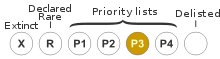
Eremophila campanulata is classified as "Priority Three" by the Western Australian Government Department of Parks and Wildlife[5] meaning that it is poorly known and known from only a few locations but is not under imminent threat.[6]
References
- 1 2 3 "Eremophila campanulata". APNI. Retrieved 26 December 2015.
- 1 2 3 Chinnock, R.J. (Bob) (2007). Eremophila and allied genera : a monograph of the plant family Myoporaceae (1st ed.). Dural, NSW: Rosenberg. pp. 544–546. ISBN 9781877058165.
- 1 2 3 4 Brown, Andrew; Buirchell, Bevan (2011). A field guide to the eremophilas of Western Australia (1st ed.). Hamilton Hill, W.A.: Simon Nevill Publications. p. 54. ISBN 9780980348156.
- ↑ "campanula". Wiktionary. Retrieved 26 December 2015.
- 1 2 "Eremophila campanulata". FloraBase. Western Australian Government Department of Parks and Wildlife.
- ↑ "Conservation codes for Western Australian Flora and Fauna" (PDF). Government of Western Australia Department of Parks and Wildlife. Retrieved 26 December 2015.