Eucalyptus ovata
| Eucalyptus ovata | |
|---|---|
 | |
| Eucalyptus ovata | |
| Scientific classification | |
| Kingdom: | Plantae |
| (unranked): | Angiosperms |
| (unranked): | Eudicots |
| (unranked): | Rosids |
| Order: | Myrtales |
| Family: | Myrtaceae |
| Genus: | Eucalyptus |
| Species: | E. ovata |
| Binomial name | |
| Eucalyptus ovata Labill.[1] | |
 | |
| E. ovata, field distribution | |
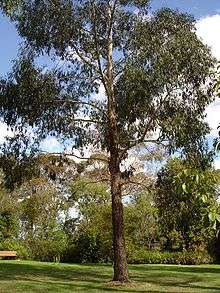
Eucalyptus ovata, commonly known as Swamp Gum or Black Gum, is a widespread occurring Australian eucalypt. The species was first described in 1806 by Jacques Labillardière in Novae Hollandiae plantarum specimen.[2] The locality given in that work is "in terrâ Van-Leuwin", indicating Southwest Australia, but the species does not occur in that region.
Description
The swamp gum is a small to medium-sized tree, rarely a mallee, with bark that sheds over most of the trunk revealing a smooth, grey, whitish or pinkish-grey surface. The rough bark is retained at the base on larger trees. Leaves are stalked, broad lanceolate, undulate to 19 x 8.5 cm dull and green. White flowers appear in autumn to mid-winter. It can reach a height of 30 metres.[3] It is variable in habit from straggly saplings (in east Gippsland) to stout boled trees.[4]
Distribution and habitat
The tree is widespread from the western end of Kangaroo Island, the southern Mount Lofty ranges and the south-east of South Australia, Tasmania, the southern part of Victoria and south-eastern New South Wales, preferring valleys and poorly drained flat areas.
References
- ↑ Labillardiere, J.J.H. de (1806). Novae Hollandiae Plantarum Specimen. 2. Paris, France: Ex typographia Dominæ Huzard. p. 51.
- ↑ "Eucalyptus ovata Labill.". Australian Plant Name Index (APNI), IBIS database. Centre for Plant Biodiversity Research, Australian Government.
- ↑ Hill, K. "Eucalyptus ovata Labill.". PlantNET. National Herbarium of New South Wales. Retrieved 2009-02-10.
- ↑ Brooker & Kleinig, Field Guide to Eucalypts, Vol 2 South Western and Southern Australia, Bloomings Books, Melbourne, 2001, ISBN 1-876473-28-2