Eugène-Louis Lequesne
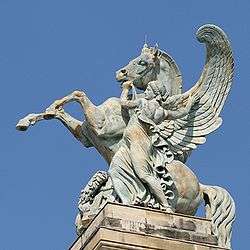
La Renommée retenant Pégase, Palais Garnier, Paris
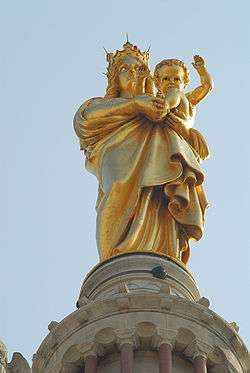
La bonne mère, Notre-Dame de la Garde, Marseille
Eugène-Louis Lequesne (or Le Quesne) (15 February 1815 – 3 June 1887) was a French sculptor.[1]
Lequesne was born and died in Paris. In 1841, he entered the École nationale des beaux-arts, in James Pradier's workshop. In 1843, he won the second Prix de Rome, and in 1844 the first prize, with a plaster bas-relief entitled Pyrrhus tuant Priam. He lived at the Académie de France à Rome from 1844 to 1849, alongside Jean-Louis Charles Garnier. In 1855, he was awarded the Great Prize for sculpture at the Exposition Universelle, and received the Légion d'honneur.
Main works
- figures representing Rouen and Amiens, on the facade of the Gare du Nord, Paris, circa 1862
- colossal finial figure of La Bonne Mère, Notre-Dame de la Garde, Marseille, 1867
- plaster figure of Camulogene, Palais des Beaux-Arts de Lille, 1872
- two Pégase, Palais Garnier, Paris
- Faune dansant, jardin du Luxembourg, Paris
- La Foi, La Charité et L'Espérance, Église de la Ste.-Trinité, Paris
- Thuillier Constant, du Cange, L'Industrie, La Sculpture, museum of Amiens
- Masque d’Homère, museum of Beaufort
- Faune dansant, museum of Bordeaux
- Prêtresse de Bacchus, museum de Cambrai
- À quoi rêvent les jeunes filles and Vercingétorix vaincu défiant les soldats romains, museum of Chartres
- Le buste de Laënnec, Faculté de médecine de Paris
- Thuillier, museum of Roanne
- Le maréchal de Saint Amand, museum of Versailles
- Renommée retenant Pégase, Musée d'Orsay, Paris[2]
References
- ↑ "LEQUESNE (ou LE QUESNE) Eugène Louis" (in French). Héritage des Échecs Français. Retrieved 2009-06-30.
- ↑ "Eugène Louis Lequesne, Renommée retenant Pégase, en 1865" (in French). Musée d'Orsay. Retrieved 2009-06-30.
 |
Wikimedia Commons has media related to Eugène Lequesne. |
External links
- (French) Works by Lequesne, on Paris Sculptures (photos)
- Eugène-Louis Lequesne in American public collections, on the French Sculpture Census website

This article is issued from Wikipedia - version of the 10/10/2016. The text is available under the Creative Commons Attribution/Share Alike but additional terms may apply for the media files.