First Church in Salem
| First Church in Salem | |
|---|---|
| First Church in Salem, Unitarian | |
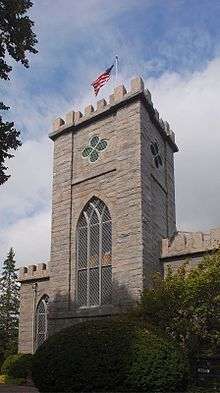 Pictured in 2010 | |
| 42°31′17″N 70°53′58″W / 42.5215°N 70.8994°WCoordinates: 42°31′17″N 70°53′58″W / 42.5215°N 70.8994°W | |
| Location | Salem, Massachusetts |
| Country | United States |
| Denomination | Unitarian Universalism |
| Previous denomination | Puritanism |
| Website |
firstchurchinsalem |
| Architecture | |
| Architect(s) | Solomon Willard |
| Architectural type | Gothic Revival |
| Completed | 1836 |
| Clergy | |
| Minister(s) | Jeff Barz-Snell |
First Church in Salem (officially known as the First Church in Salem, Unitarian Universalist) is a Unitarian Universalist church in Salem, Massachusetts that was designed by Solomon Willard and built in 1836.[1] The congregation claims to be "one of the oldest continuing Protestant churches in North America and the first to be governed by congregational polity, a central feature of Unitarian Universalism".[2]
Thomas Treadwell Stone became minister of the church on July 12, 1846.[3] In December 1851, the Salem Female Anti-Slavery Society held their annual general meeting at the church.[4] For twelve years, Charles Wentworth Upham was minister of the church.[5] Grace Parker commissioned a stained-glass window for the church in dedication to her late husband, George Swinnerton Parker of Parker Brothers fame, and their two sons.[6]
References
- ↑ Blanche M. G. Linden (2007). Silent City on a Hill: Picturesque Landscapes of Memory and Boston's Mount Auburn Cemetery. University of Massachusetts Press. p. 218. ISBN 1558495711.
- ↑ http://firstchurchinsalem.org/
- ↑ William Lloyd Garrison (1973). The Letters of William Lloyd Garrison: No Union with the Slaveholders, 1841-1849. Harvard University Press. p. 343. ISBN 0674526627.
- ↑ Laura L. Mitchell (1998). John R. McKivigan, Mitchell Snay, eds. "Matters of Justice Between Man and Man". Religion and the Antebellum Debate Over Slavery. University of Georgia Press: 154. ISBN 0820319724.
- ↑ Alfred F. Rosa (1980). Salem, Transcendentalism, and Hawthorne. Fairleigh Dickinson University Press. p. 99. ISBN 0838621597.
- ↑ Philip Orbanes (2004). The Game Makers: The Story of Parker Brothers from Tiddledy Winks to Trivial Pursuit. Harvard Business Press. p. 126. ISBN 1591392691.