First-preference votes
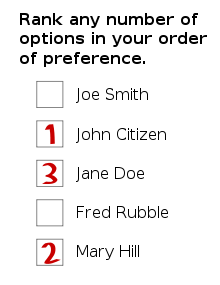
In ranked voting systems, a first-preference vote (or first preference, 1st preference, or primary vote) is the individual voter's first choice amongst (possibly) many.[1][2][3][4] Every such system is designed, in the first instance, to align the result with the candidate(s)/option(s) which have obtained the highest number of first-preferences, and then, if necessary, this criteria is altered to allow for proportionality, and to carry surplus and/or ineffective votes to second and subsequent options depending on the system involved. Ballots with no clear first preference (no preference, or multiple first preferences) are generally regarded as a spoilt vote The term is also used (trivially) in first past the post systems.[5] First preference votes are used by psephologists and the print and broadcast media to broadly describe the state of the parties at elections and swing between elections.[4][5][6]
References
- ↑ "Explainer: What is preferential voting?". Special Broadcasting Service.
- ↑ "How the Dáil is Elected" (PDF). Department of the Environment, Community and Local Government, (Ireland). November 2014. p. 10. Retrieved 24 May 2015.
- ↑ ""Full transcript - David Cameron - The case against AV - London - 18 February 2011"". New Statesman. 18 February 2011. Retrieved 24 May 2015.
- 1 2 "By-Election: Carlow-Kilkenny". RTÉ. 23 May 2015. Retrieved 24 May 2015.
- 1 2 "First Preference Vote". University of Western Australia. Retrieved 24 May 2015.
- ↑ "Cooma-Monaro Shire Council: Summary of First Preference Votes for each Candidate". Local Government Elections 2012. Electoral Commission of New South Wales. 14 September 2012. Retrieved 7 October 2012.