Flip-screen
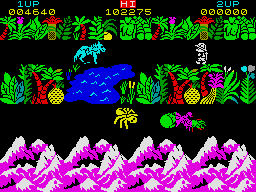
In video games, flip-screen is a principle where the playing environment is divided into single-screen portions (viewed from above or the side, or, more seldom, via an isometric view). Players see only one such screen at a time, and move to the next screen by having the player avatar exit the current screen via one of the display's edges. At the point when the screen-to-next-screen move is performed, the picture abruptly "flips" to the next screen, hence the technique's name.[1][2]
Examples
Some examples of flip-screen games are Adventure (Atari 2600, 1979), Space Dungeon (arcade, 1981), Castle Wolfenstein (Apple II, 1981), Galahad and the Holy Grail (Atari 8-bit family, 1982), Pitfall! (Atari 2600, 1982), Jet Set Willy (ZX Spectrum, 1984), and Prince of Persia (Apple II, 1989).
The Legend of Zelda resembles flip-screen games in that action takes place within discrete areas the size of the screen, but it uses a scrolling transition from each area to the next.
See also
References
- ↑ "Spindizzy review". Zzap!64. June 1986. Retrieved 25 February 2011.
- ↑ "Amaurote review". Crash. May 1987. Retrieved 25 February 2011.