Fred Taylor (physicist)
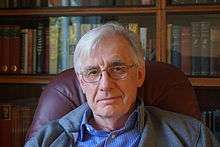
Fredric William Taylor is a British physicist and academic. He is Halley Professor of Physics Emeritus at the University of Oxford.[1][2]
Early life and education
Taylor was born in Amble, Northumberland, England. His father, William, was a joiner who had been wounded in World War II, and his mother, Ena, was a teacher. In 1949, the family moved to Howick, Northumberland.[3] He was educated at The Duke's School, then an all-boys school in Alnwick.[3][4] He studied physics at the University of Liverpool, graduating with a first class Bachelor of Science (BSc) degree.[5] He then undertook postgraduate research in atmospheric physics at Jesus College, Oxford under the supervision of Sir John Houghton, and graduated from the University of Oxford with a Doctor of Philosophy (DPhil) degree.[3][5]
Academic career
In 1970, Taylor joined the Jet Propulsion Laboratory of the California Institute of Technology.[3][6] He was principal investigator for the first experiment into the meteorology of the atmosphere of Venus, building an instrument for the Pioneer Venus Orbiter that launched in 1978.[5] Arriving at Venus in December 1978, this included the first British-built hardware to travel to another planet.[7] He was also involved in the mission that sent the unmanned spacecraft Galileo to study Jupiter and its moons.[5]
In 1980, he returned to Oxford University where he became Professor and Head of Department.[3] Under his leadership, the Group was involved in space missions to study the atmospheres of Earth, Venus, Mars, Jupiter, Saturn and Titan, as well as Mercury, the Moon, and a comet.[8] In 1999, one of the Oxford projects placed the first British-built hardware on the surface of Mars, albeit unwittingly.[9]
Taylor has written twelve books on atmospheric and planetary physics.[10][11] In September 2011, he retired from full-time academia and from the Halley Professorship of Physics.[6]
Selected works
- Academic
- Taylor, Fredric W. (2001). The Cambridge photographic guide to the planets. Cambridge: Cambridge University Press. ISBN 978-0521781831.
- Lopez-Puertas, Manuel; Taylor, Fredric W. (2001). Non-Local Thermodynamic Equilibrium in Atmospheres. Singapore: World Scientific. ISBN 978-9810245665.
- Taylor, F. W. (2005). Elementary climate physics. Oxford: Oxford University Press. ISBN 978-0198567332.
- Coustenis, Athena; Taylor, Fredric W. (2008). Titan: exploring an earthlike world (2nd ed.). Singapore: World Scientific. ISBN 978-9812705013.
- Taylor, Fredric W. (2010). The scientific exploration of Mars. Cambridge: Cambridge University Press. ISBN 978-0521829564.
- Taylor, F. W. (2010). Planetary Atmospheres. Oxford: Oxford University Press. ISBN 978-0199547425.
- Vardavas, Ilias; Taylor, Fredric W. (2011). Radiation and Climate (2nd ed.). Oxford: Oxford University Press. ISBN 978-0199697144.
- Taylor, Fredric W. (2014). The scientific exploration of Venus. Cambridge: Cambridge University Press. ISBN 978-1107023482.
- Personal
- Taylor, Fred (2016). Exploring the Planets: A Memoir. Oxford: Oxford University Press. ISBN 978-0199671595.
References
- ↑ "Fred Taylor: A glimpse of my own future, and a girl to boot". Times Higher Education. 31 March 2006. Retrieved 31 March 2014.
- ↑ "David Bates Medal: Prof Fred Taylor". European Geophysical Union. Retrieved 25 March 2016.
- 1 2 3 4 5 "Stargazing fans, meet Amble's own space man". The Ambler. 14 December 2012. Retrieved 15 December 2015.
- ↑ "The History of The Duke's Middle School". The Duke's Middle School, Alnwick. Retrieved 15 December 2015.
- 1 2 3 4 "F. W. Taylor". Amazon.co.uk. Retrieved 16 March 2016.
- 1 2 "Fred Taylor". Department of Physics. University of Oxford. Retrieved 16 March 2016.
- ↑ Taylor, Fredric W. (2014). The scientific exploration of Venus. Cambridge: Cambridge University Press. ISBN 978-1107023482.
- ↑ Taylor, Fred (2016). Exploring the Planets: A Memoir. Oxford: Oxford University Press. ISBN 978-0199671595.
- ↑ Taylor, Fredric W. (2010). The scientific exploration of Mars. Cambridge: Cambridge University Press. ISBN 978-0521829564.
- ↑ "Professor Fred Taylor". Jesus College. University of Oxford. Retrieved 16 March 2016.
- ↑ See his comment underneath http://www.theambler.co.uk/2012/03/05/mapping-the-world-and-beyond/