French ship Seine (1845)
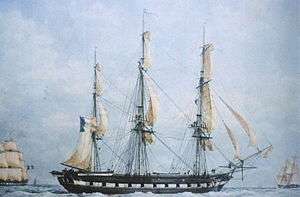 Portrait of Durance, sister-ship of Seine, by François Roux. | |
| History | |
|---|---|
 France France | |
| Name: | Seine |
| Namesake: | Seine |
| Builder: | Rochefort [1] |
| Laid down: | 26 May 1842 [1] |
| Launched: | 22 February 1845 [1] |
| Commissioned: | September 1845 [1] |
| Fate: | Wrecked off Port-de-France (now Nouméa) [1] |
| General characteristics | |
| Type: | Fluyt |
| Tons burthen: | 800 tonnes |
| Length: | Circa 43.40 metres [2][3] |
| Beam: | 10.40 metres [2][3] |
| Draught: | 4.33 to 5.64 metres [2][3] |
| Propulsion: | Sail |
| Crew: | 154 [2] 232 with troops [4][5] |
| Armament: | 22 30-pounders (16cm howitzers), 4 8-pounders [1][3] |
| Armour: | Timber |
Seine was a fluyt of the French Navy. Sent to the Pacific in a time of colonial rivalry with the United Kingdom to both consolidate French positions and diplomatically ease tensions with the British, she ran aground off Port-de-France (now Nouméa) and was wrecked. The remains of the ship have become a subject of interest for maritime archeology, notably yielding a rare example of a desalination device of the 1840s.
Career
Designed as a fluyt, or "corvette of burden",[notes 1] Seine was built under the direction of Bernard Chariot upon plans drawn by Forfait and revised by Sané, with notably a hull sheathed in bronze.[3]
Seine left Brest on 3 September 1845, under Lieutenant Commander François Leconte,[4][5] to take the New Zealand station and relieve Rhin.[1]
Seine ferried troops to Tahiti, where the British encouraged the local population to riot against the French,[6] which had led Dupetit Thouars to expel British consul George Pritchard to Australia.[7]
She also carried a letter from Minister Mackau to renounce sovereignty over New Caledonia and ease tensions with the British in the Pacific.[4][5][6]
Fate
On 4 July 1846, she ran aground off Port-de-France (now Nouméa) and became a total loss.[1] The crew abandoned ship with no loss of life[notes 2] and spent two months at Pouébo before the British ship Arabian rescued them.[6] The diplomatic letters reached the British via Bishop Guillaume Douarre.[4][5]
Legacy
On 28 May 1968, French Navy frogmen of the Dunkerquoise[6] located the wreck of Seine in 23-metre deep waters,[8] near Pouébo.[4][5] Between 7 and 18 April 1997, Laplace conducted a survey of the wreckage, with the local association Fortunes de Mer Calédonienne.[6]
The wreck triggered interest as carrying the lone surviving example of a Peyre et Rocher desalination system, invented in 1840 by chemist Peyre and industrialist Rocher and used on long-haul ships. The system used waste heat from the kitchen of the ship to desalinate water in a 1.2-ton copper cubic cistern.[4][5] The device was located 20 metres from the wreck.[8]
Citations and references
Notes
Citations
- 1 2 3 4 5 6 7 8 Roche, vol.1, p.410
- 1 2 3 4 Corvettes de charge (ex-flûtes)
- 1 2 3 4 5 Demerliac, p.165, no 994
- 1 2 3 4 5 6 Une pièce très rare remontée de l'épave d'un bateau parti de Brest en 1845, france3-regions
- 1 2 3 4 5 6 Une pièce peut-être unique au monde remontée de l'épave d'un bateau au curieux destin, www.tntv.pf
- 1 2 3 4 5 La Seine, museemaritime.nc
- ↑ La Seine et sa double barre à roue, subaqua.ffessm.fr
- 1 2 Découverte d'une cuisine distillatoire du XIXe siècle sur l'épave de la corvette LA SEINE, museemaritime.nc
References
- Roche, Jean-Michel (2005). Dictionnaire des bâtiments de la flotte de guerre française de Colbert à nos jours. 1. Group Retozel-Maury Millau. p. 169. ISBN 978-2-9525917-0-6. OCLC 165892922.
- Demerliac, Alain (2004). La Marine de la Restauration et du Louis-Phillipe 1er: Nomenclature des Navires Français de 1815 A 1848 (in French). Éditions Ancre. ISBN 2-906381-23-3.