GPR35
| GPR35 | |||||||||||||||||
|---|---|---|---|---|---|---|---|---|---|---|---|---|---|---|---|---|---|
| Identifiers | |||||||||||||||||
| Aliases | GPR35 | ||||||||||||||||
| External IDs | MGI: 1929509 HomoloGene: 3874 GeneCards: GPR35 | ||||||||||||||||
| Genetically Related Diseases | |||||||||||||||||
| inflammatory bowel disease, ulcerative colitis, sclerosing cholangitis[1] | |||||||||||||||||
| Targeted by Drug | |||||||||||||||||
| bumetanide, furosemide, kynurenic acid, pamoic acid, zaprinast[2] | |||||||||||||||||
| |||||||||||||||||
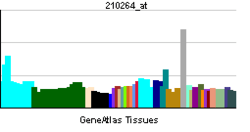
| RNA expression pattern | |||||||||||||||||
 | |||||||||||||||||
| More reference expression data | |||||||||||||||||
| Orthologs | |||||||||||||||||
| Species | Human | Mouse | |||||||||||||||
| Entrez | |||||||||||||||||
| Ensembl | |||||||||||||||||
| UniProt | |||||||||||||||||
| RefSeq (mRNA) | |||||||||||||||||
| RefSeq (protein) | |||||||||||||||||
| Location (UCSC) | Chr 2: 240.61 – 240.63 Mb | Chr 1: 92.95 – 92.99 Mb | |||||||||||||||
| PubMed search | [3] | [4] | |||||||||||||||
| Wikidata | |||||||||||||||||
| View/Edit Human | View/Edit Mouse |
G protein-coupled receptor 35 also known as GPR35 is a G protein-coupled receptor which in humans is encoded by the GPR35 gene.[5] Heightened expression of GPR35 is found in immune and gastrointestinal tissues, including the crypts of Lieberkühn.
Ligands
Agonists
Selective agonists of GPR35 include:
- 5-nitro-2-(3-phenylpropylamino) benzoic acid[6]
- Kynurenic acid[6][7]
- Lysophosphatidic acid[6]
- Pamoic acid[6]
- Zaprinast[6][8]
Antagonists
Antagonists of GPR35 include:
Clinical significance
Deletion of GPR35 gene may be responsible for brachydactyly mental retardation syndrome and is mutated in 2q37 monosomy and 2q37 deletion syndrome.[10] In one study GPR35 has been recognised as a potential oncogene in stomach cancer.[11]
References
- ↑ "Diseases that are genetically associated with GPR35 view/edit references on wikidata".
- ↑ "Drugs that physically interact with G-protein coupled receptor 35 view/edit references on wikidata".
- ↑ "Human PubMed Reference:".
- ↑ "Mouse PubMed Reference:".
- ↑ O'Dowd BF, Nguyen T, Marchese A, Cheng R, Lynch KR, Heng HH, Kolakowski LF, George SR (1998). "Discovery of three novel G-protein-coupled receptor genes". Genomics. 47 (2): 310–3. doi:10.1006/geno.1998.5095. PMID 9479505.
- 1 2 3 4 5 Zhao, Pingwei; Sharir, Haleli; Kapur, Ankur; Cowan, Alan; Geller, Ellen B; Adler, Martin W; Seltzman, Herbert H; Reggio, Patricia H; Heynen-Genel, Susanne; Sauer, Michelle; Chung, Thomas D Y; Bai, Yushi; Chen, Wei; Caron, Marc G; Barak, Larry S; Abood, Mary E (2010). "Targeting of the orphan receptor GPR35 by pamoic acid: a potent activator of extracellular signal-regulated kinase and β-arrestin2 with antinociceptive activity.". Molecular Pharmacology. 78 (4): 560–568. doi:10.1124/mol.110.066746. PMC 2981393
 . PMID 20826425.
 - ↑ Wang J, Simonavicius N, Wu X, Swaminath G, Reagan J, Tian H, Ling L (2006). "Kynurenic acid as a ligand for orphan G protein-coupled receptor GPR35". J. Biol. Chem. 281 (31): 22021–8. doi:10.1074/jbc.M603503200. PMID 16754668.free fulltext
- ↑ Taniguchi Y, Tonai-Kachi H, Shinjo K (2006). "Zaprinast, a well-known cyclic guanosine monophosphate-specific phosphodiesterase inhibitor, is an agonist for GPR35". FEBS Lett. 580 (21): 5003–8. doi:10.1016/j.febslet.2006.08.015. PMID 16934253.
- 1 2 Susanne Heynen-Genel; Russell Dahl; Shenghua Shi; Michelle Sauer; Santosh Hariharan; Eduard Sergienko; Shakeela Dad; Thomas DY Chung; Derek Stonich; Ying Su; Marc Caron; Pingwei Zhao; Mary E Abood; Lawrence S Barak (2010). "Selective GPR35 Antagonists - Probes 1 & 2". PMID 21433393. Bookshelf ID NBK50703.
- ↑ Shrimpton AE, Braddock BR, Thomson LL, Stein CK, Hoo JJ (2004). "Molecular delineation of deletions on 2q37.3 in three cases with an Albright hereditary osteodystrophy-like phenotype". Clin. Genet. 66 (6): 537–44. doi:10.1111/j.1399-0004.2004.00363.x. PMID 15521982.
- ↑ Okumura S, Baba H, Kumada T, Nanmoku K, Nakajima H, Nakane Y, Hioki K, Ikenaka K (2004). "Cloning of a G-protein-coupled receptor that shows an activity to transform NIH3T3 cells and is expressed in gastric cancer cells". Cancer Sci. 95 (2): 131–5. doi:10.1111/j.1349-7006.2004.tb03193.x. PMID 14965362.