General Leibniz rule
| Part of a series of articles about | ||||||
| Calculus | ||||||
|---|---|---|---|---|---|---|
|
||||||
|
Specialized |
||||||
In calculus, the general Leibniz rule,[1] named after Gottfried Leibniz, generalizes the product rule (which is also known as "Leibniz's rule"). It states that if u and v are n-times differentiable functions, then product uv is also n-times differentiable and its nth derivative is given by
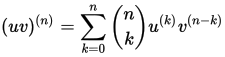
where is the binomial coefficient.
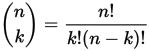
This can be proved by using the product rule and mathematical induction.
Second derivative
In case :


More than two factors
The formula can be generalized to the product of m differentiable functions f1,...,fm.

where the sum extends over all m-tuples (k1,...,km) of non-negative integers with and


are the multinomial coefficients. This is akin to the multinomial formula from algebra.
Multivariable calculus
With the multi-index notation for partial derivatives of functions of several variables, the Leibniz rule states more generally:
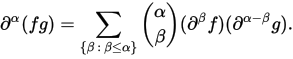
This formula can be used to derive a formula that computes the symbol of the composition of differential operators. In fact, let P and Q be differential operators (with coefficients that are differentiable sufficiently many times) and . Since R is also a differential operator, the symbol of R is given by:


A direct computation now gives:

This formula is usually known as the Leibniz formula. It is used to define the composition in the space of symbols, thereby inducing the ring structure.
See also
Notes
- ↑ Olver, Applications of Lie groups to differential equations, page 318