Gig (carriage)
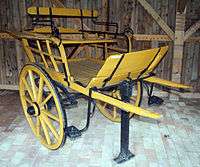
A gig, also called chair or chaise, is a light, two-wheeled sprung cart pulled by one horse.
Description
Gig carts are constructed with the driver's seat sitting higher than the level of the shafts.[1] Traditionally, a gig is more formal[2] than a village cart or a meadowbrook cart, and more comfortable, usually being sprung.[3] A light gig can be used for carriage racing. OED gives the date of first known reference to a horse-drawn gig as 1791, and they were ubiquitous by the early 1800s.[4] There are several types of gig,[5][6][7] including:[8]
- calesín: small, one-horse, hooded, a seat behind for the driver, used in the Philippines; diminutive of Spanish calesa
- stanhope: typically having a high seat and closed back; named after Fitzroy Stanhope, a British clergyman who died in 1864.
- stick gig: lightweight, two-wheeled, for one person
- Tilbury (carriage), lightweight, two-wheeled,
- whiskey or whisky: small body that resembles a chair, suspended on leather braces attached to springs
Gigs travelling at night would normally carry two oil lamps with thick glass, known as gig-lamps.
The meaning of the term 'gig' is transferred from the deprecatory term for a 'flighty girl' and subsequently indicates anything which whirls, or is dangerous or unpredictable.[9] Contemporary literature frequently recounted romantic tales of spills and hairbreadth scrapes from these vehicles, but is equally fulsome on the fearful thrill experienced in driving them.[10]
References
- ↑ Felton, W. (1796). A Treatise on Carriages: Comprehending Coaches, Chariots, Phaetons, Curricles, Gigs, Whiskies... Together with Their Proper Harness. In which the Fair Prices of Every Article are Accurately Stated (Vol. 2). Debrett.
- ↑ Loudon, I. (2001). Doctors and their transport, 1750–1914. Medical history, 45(02), 185-206.
- ↑ CANTLE, G. S. (1978). The Steel Spring Suspensions of Horse-Drawn Carriages (circa 1760 to 1900). Transactions of the Newcomen Society, 50(1), 25-36.
- ↑ Byrne, A. (2015). " Very Knowing Gigs": Social Aspiration and the Gig Carriage in Jane Austen's Works. Persuasions: The Jane Austen Journal, 37, 198.
- ↑ Newlin, A. (1940). An Exhibition of Carriage Designs. The Metropolitan Museum of Art Bulletin, 35(10), 186-191.
- ↑ Nockolds, H. (Ed.). (1977). The Coachmakers: A History of the Worshipful Company of Coachmakers and Coach Harness Makers, 1677-1977. JA Allen, Limited.
- ↑ McCausland, H. (2013). The English Carriage. Read Books Ltd.
- ↑ For descriptions and definitions see: Berkebile, D. H. (2014). Carriage terminology: an historical dictionary. Smithsonian Institution.
- ↑ Oxford University Press (2000). The Oxford English dictionary online. Oxford University Press, Oxford
- ↑ Bradney, J. (2005). The carriage-drive in Humphry Repton's landscapes. Garden History, 31-46.
External links
- Gigs, Cabriolets and Curricles. Jane Austen Centre Bath UK England.