Gordoservon
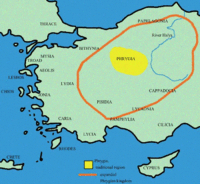
In records from Bithynia in the year 680, the city of Gordoservon or Gordoserbon (Greek: Γορδόσερβον, Proto-Slavic: *Gordŭ Sĭrbŭ, Serbian: Srbograd, Grad Srba, Гордосервон) was a Byzantine city inhabited by Serbs. The name is derived from the Serbs that resettled in Asia Minor (in ca 649[1] or 667[2]) by Byzantine Emperor Constans II (641–668), who came from the areas "around the river Vardar". A "Bishop of Gordoservon" named Isidore is mentioned in 680/681, and the fact that this town was an episcopal seat gives ground to the thesis that it had a large Serbian population. The Serbs were recruited in large numbers into the Byzantine army especially under Justinian II in the 680s, until the defection of a 30,000-strong Serbian contingent led to the disastrous loss of the Battle of Sebastopolis in 692/693.
Around the year 1200 AD this city is mentioned as Servochoria (Greek: Σερβοχώρια, "Serbian habitations"). The city was situated where the Phrygian kingdom once had been.
References
- ↑ North American Society for Serbian Studies (1995). Serbian Studies. North American Society for Serbian Studies. ISSN 0742-3330. Retrieved 2014-12-11.
- ↑ Kostelski, Z. (1952). The Yugoslavs: the history of the Yugoslavs and their states to the creation of Yugoslavia. Philosophical Library. Retrieved 2014-12-11.
Sources
- Erdeljanovich. J. "O naseljavanju Slovena u Maloj Aziji i Siriji od VII do X veka" Glasnik geografskog drushtva vol. VI 1921 pp. 189
- Lequien, M., "Oriens Christianus" I, 1740, pp. 659–660
- Micotky, J., "Otiorum Chroate", Vol. I, Budapest, 1806, pp. 89–112
- Lubor Niederle, "Slovanske starozhitnosti" Dilu II, Svazek pp. 389–399; pp. 444–446
- Ostrogorski, G. "Bizantisko-Juzhnoslovenski odnosi", Enciklopedija Jugoslavije 1, Zagreb 1955, pp. 591–599
- Ramsay, W. M. "The Historical Geography Of Asia Minor", London, 1890, pp. 183, pp. 210
Further reading
- T. Lewicki (1964). "Gordoserba (Gordoservon)". Slownik starozytn. slowiariskich II (1): 131.