HD 219134 b
| Exoplanet | List of exoplanets | |
|---|---|---|
 | ||
| Parent star | ||
| Star | HR 8832 | |
| Constellation | Cassiopeia | |
| Right ascension | (α) | 23h 13m 16.9763s[1] |
| Declination | (δ) | +57° 10′ 06.082″[1] |
| Apparent magnitude | (mV) | 5.574[2] |
| Distance | 21.25[3] ly (6.52 pc) | |
| Spectral type | K3V[4] | |
| Mass | (m) | 0.794+0.037 −0.022[5] M☉ |
| Radius | (r) | 0.80 (± 0.04)[6] R☉ |
| Temperature | (T) | 4710[4] K |
| Metallicity | [Fe/H] | +0.20[4] |
| Age | ~12.46[5] Gyr | |
| Orbital elements | ||
| Semi-major axis | (a) | 0.0382 (± 0.0003)[7] AU |
| Eccentricity | (e) | 0.00+0.13 −0.0[7] |
| Orbital period | (P) | 3.0937 (± 0.0004)[7] d |
| Inclination | (i) | 85.058 ± 0.08[7]° |
| Physical characteristics | ||
| Mass | (m) | 4.47 (± 0.47)[7] M⊕ |
| Radius | (r) | 1.606 (± 0.086)[7] R⊕ |
| Density | (ρ) | 5.89 (± 1.17)[7] g cm−3 |
| Temperature | (T) | 800 K (527 °C; 980 °F) |
| Discovery information | ||
| Discovery date | 30 July 2015 | |
| Discoverer(s) | ||
| Discovery method | radial velocity method (HARPS-N) | |
| Other detection methods | transiting (Spitzer telescope) | |
| Discovery site | HARPS-N of the Telescopio Nazionale Galileo | |
| Discovery status | Published | |
| Database references | ||
| Extrasolar Planets Encyclopaedia | data | |
| SIMBAD | data | |
| Exoplanet Archive | data | |
| Open Exoplanet Catalogue | data | |
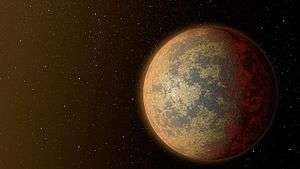
HD 219134 b (or HR 8832 b) is one of seven exoplanets orbiting HR 8832, a main-sequence star in the constellation of Cassiopeia.[3][7][8][9] As of July 2015, super-Earth HD 219134 b, with a size of about 1.6 Earth Radii, and a density of 6g/cm3, was reported as the closest rocky exoplanet to the Earth, at 21.25 light-years away.[3] The exoplanet was initially detected by the instrument HARPS-N of the Italian Telescopio Nazionale Galileo via the radial velocity method and subsequently observed by the Spitzer telescope as transiting in front of its star.[3][8] The exoplanet has a mass of about 4.5 times that of Earth and orbits its host star every three days.[3]
Characteristics
Mass, radius and temperature
HD 219134 b is a super-Earth, an exoplanet with a radius and mass bigger than Earth, but smaller than that of the ice giants Neptune and Uranus. Its surface temperature is around 800 K (527 °C; 980 °F). It has a radius of 1.6 R⊕ and a mass of around 4.5 M⊕.
Host star
The planet orbits a (K-type) star named HR 8832, orbited by a total of seven planets. The star has a mass of 0.79 M☉ and a radius of 0.80 R☉. It has a temperature of 4710 K and is about 12.5 billion years old, making it one of the oldest stars. In comparison, the Sun is 4.6 billion years old[10] and has a temperature of 5778 K.[11]
The star's apparent magnitude, or how bright it appears from Earth's perspective, is 5. It can be seen with the naked eye.
Orbit
HD 219134 b orbits its host star with about 28% of the Sun's luminosity with an orbital period of 3 days and an orbital radius of about 0.03 times that of Earth's (compared to the distance of Mercury from the Sun, which is about 0.38 AU).
Gallery
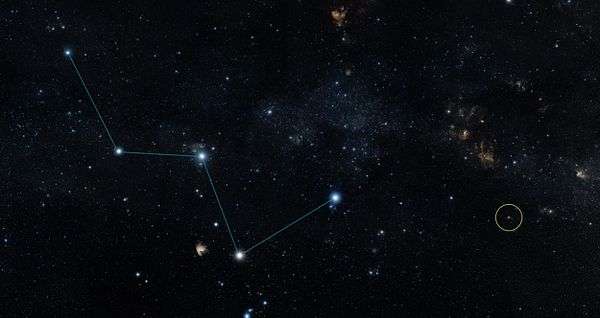
(00:53; animation; July 30, 2015).
See also
References
- 1 2 van Leeuwen, F. (November 2007), "Validation of the new Hipparcos reduction", Astronomy and Astrophysics, 474 (2): 653–664, arXiv:0708.1752
 , Bibcode:2007A&A...474..653V, doi:10.1051/0004-6361:20078357.
 - ↑ Oja, T. (August 1986), "UBV photometry of stars whose positions are accurately known. III", Astronomy and Astrophysics Supplement Series, 65 (2): 405–409, Bibcode:1986A&AS...65..405O.
- 1 2 3 4 5 Chou, Felicia; Clavin, Whitney (30 July 2015). "NASA's Spitzer Confirms Closest Rocky Exoplanet". NASA. Retrieved 31 July 2015.
- 1 2 3 Frasca, A.; et al. (December 2009), "REM near-IR and optical photometric monitoring of pre-main sequence stars in Orion. Rotation periods and starspot parameters", Astronomy and Astrophysics, 508 (3): 1313–1330, Bibcode:2009A&A...508.1313F, doi:10.1051/0004-6361/200913327.
- 1 2 Takeda, Genya; et al. (February 2007), "Structure and Evolution of Nearby Stars with Planets. II. Physical Properties of ~1000 Cool Stars from the SPOCS Catalog", The Astrophysical Journal Supplement Series, 168 (2): 297–318, arXiv:astro-ph/0607235, Bibcode:2007ApJS..168..297T, doi:10.1086/509763.
- ↑ Perrin, M.-N.; Karoji, H. (1987), "Stellar radius determination from IRAS 12-micron fluxes", Astronomy and Astrophysics, 172: 235–240, Bibcode:1987A&A...172..235P.
- 1 2 3 4 5 6 7 8 Motalebi, F.; et al. "The HARPS-N Rocky Planet Search, I. HD 219134b: A transiting rocky planet in a multi-planet system at 6.5 pc from the Sun". Astronomy and Astrophysics. arXiv:1507.08532. Bibcode:2015A&A...584A..72M. doi:10.1051/0004-6361/201526822.
- 1 2 "PIA19832: Location of Nearest Rocky Exoplanet Known". NASA. 30 July 2015. Retrieved 30 July 2015.
- ↑ PLANET HOST OVERVIEW PAGE
- ↑ Fraser Cain (16 September 2008). "How Old is the Sun?". Universe Today. Retrieved 19 February 2011.
- ↑ Fraser Cain (15 September 2008). "Temperature of the Sun". Universe Today. Retrieved 19 February 2011.
External links
- Cassiopeia Constellation at Constellation Guide
- The Deep Photographic Guide to the Constellations: Cassiopeia
2015 in space | ||||||||
|---|---|---|---|---|---|---|---|---|
| Launches |    | |||||||
| Impact events | ||||||||
| Selected comets | ||||||||
| Selected NEOs | ||||||||
| Exoplanets | ||||||||
| Galaxies | ||||||||
| Space exploration |
| |||||||
| Selected discoveries | V774104 (a TNO) | |||||||
| ||||||||

Coordinates:  23h 13m 16.98s, +57° 10′ 06.1″