HD 164922
| Observation data Epoch J2000.0 Equinox J2000.0 | |
|---|---|
| Constellation | Hercules |
| Right ascension | 18h 02m 30.86s[1] |
| Declination | +26° 18′ 46.81″[1] |
| Apparent magnitude (V) | +7.01 |
| Characteristics | |
| Spectral type | G9V[2] |
| U−B color index | 0.47 |
| B−V color index | 0.80 |
| V−R color index | 0.42 |
| R−I color index | 0.36 |
| Variable type | suspected |
| Astrometry | |
| Radial velocity (Rv) | +22.8 km/s |
| Proper motion (μ) | RA: 389.41 ± 0.36[1] mas/yr Dec.: –602.03 ± 0.52[1] mas/yr |
| Parallax (π) | 45.21 ± 0.54[1] mas |
| Distance | 72.1 ± 0.9 ly (22.1 ± 0.3 pc) |
| Absolute magnitude (MV) | 5.31 |
| Details | |
| Mass | 0.874 ± 0.012[2] M☉ |
| Radius | 0.999 ± 0.017[2] R☉ |
| Luminosity | 0.703 ± 0.017[2] L☉ |
| Surface gravity (log g) | 4.387 ± 0.014[2] cgs |
| Temperature | 5293 ± 32[2] K |
| Metallicity [Fe/H] | 0.16 ± 0.05[2] dex |
| Rotation | ~58.7 d |
| Age | 13.4 Gyr |
| Other designations | |
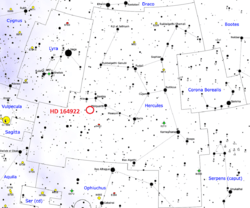
HD 164922 is a seventh magnitude G-type main sequence star in the constellation of Hercules. To view it, binoculars or a telescope are necessary, as it is too faint to be visible to the naked eye. It is 72 light years distant from the Earth.[1] At an age of 13.4 billion years, it will soon evolve away from the main-sequence and expand to become a red giant. It is one of the oldest known stars in the Universe and one of the most ancient objects known in the Milky Way.
Nomenclature
The designation b derive from the order of discovery. The designation of b is given to the first planet orbiting a given star, followed by the other lowercase letters of the alphabet.[3] In the case of HD 164922, only one was discovered, which was designated b, then a more inner planet, which was designated c.[2] The name HD 164922 derives directly from the fact that the star is the 164,922nd star discovered in the Henry Draper catalog.
Stellar characteristics
HD 164922 is a G-type main sequence star that is approximately 87% the mass of and 99% the radius of the Sun. It has a temperature of 5293 K and is 13.4 billion years old. In comparison, the Sun is about 4.6 billion years old[4] and has a temperature of 5778 K.[5]
The star is metal-rich, with a metallicity ([Fe/H]) of 0.16, or 144% the solar amount. This is particularly odd for a star as old as HD 164922. Its luminosity (L☉) is 70% of the solar luminosity.[2]
Planetary system
| Companion (in order from star) |
Mass | Semimajor axis (AU) |
Orbital period (days) |
Eccentricity | Inclination | Radius |
|---|---|---|---|---|---|---|
| c | ≥12.9 ± 1.6 M⊕ | 0.3351 ± 0.0015 | 75.765 | 0.07 | — | — |
| b | ≥0.360 ± 0.046 MJ | 2.11 ± 0.13 | 1155 ± 23 | 0.05 ± 0.14 | — | — |
On 15 July 2006, a long period Saturn-mass exoplanet was announced orbiting around HD 164922. This planet orbits at 2.11 AU from the star with a low eccentricity value of 0.05.[6]
Almost exactly ten years later in 2016, another exoplanet, though less massive then the first planet, was discovered orbiting farther in from the star. This planet has a minimum mass of nearly 13 times that of Earth, meaning it is possibly a Neptune-like planet.
References
- 1 2 3 4 5 6 van Leeuwen, F. (2007). "Validation of the new Hipparcos reduction". Astronomy and Astrophysics. 474 (2): 653–664. arXiv:0708.1752
 . Bibcode:2007A&A...474..653V. doi:10.1051/0004-6361:20078357.Vizier catalog entry
 - 1 2 3 4 5 6 7 8 9 10 Fulton, Benjamin J.; Howard, Andrew W.; Weiss, Lauren M.; Sinukoff, Evan; Petigura, Erik A.; Isaacson, Howard; Hirsch, Lea; Marcy, Geoffrey W.; Henry, Gregory W.; Grunblatt, Samuel K.; Huber, Daniel; Kaspar von Braun; Boyajian, Tabetha S.; Kane, Stephen R.; Wittrock, Justin; Horch, Elliott P.; Ciardi, David R.; Howell, Steve B.; Wright, Jason T.; Ford, Eric B. (2016). "Three Temperate Neptunes Orbiting Nearby Stars". arXiv:1607.00007 [astro-ph.EP].
- ↑ Hessman, F. V.; Dhillon, V. S.; Winget, D. E.; Schreiber, M. R.; Horne, K.; Marsh, T. R.; Guenther, E.; Schwope, A.; Heber, U. (2010). "On the naming convention used for multiple star systems and extrasolar planets". arXiv:1012.0707 [astro-ph.SR].
- ↑ Fraser Cain (16 September 2008). "How Old is the Sun?". Universe Today. Retrieved 19 February 2011.
- ↑ Fraser Cain (15 September 2008). "Temperature of the Sun". Universe Today. Retrieved 19 February 2011.
- 1 2 Butler, R. P.; et al. (2006). "Catalog of Nearby Exoplanets". The Astrophysical Journal. 646 (1): 505–522. arXiv:astro-ph/0607493. Bibcode:2006ApJ...646..505B. doi:10.1086/504701.
External links
- The Extrasolar Planet Encyclopedia: HD 164922
- SIMBAD: HD 164922
- "ARICNS: HD 164922". ARICNS. Centre of Astronomy, Heidelberg University.
Coordinates:  18h 02m 30.86s, +26° 18′ 46.81″