Heavy-lift launch vehicle
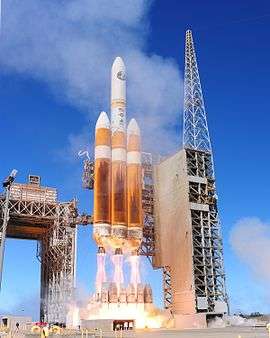
A United Launch Alliance Delta IV-Heavy rocket carrying a National Reconnaissance Office payload launches Aug. 28, 2013, from Space Launch Complex-6 at Vandenberg Air Force Base, California.
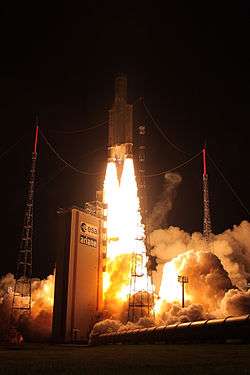
Ariane 5 ES launch
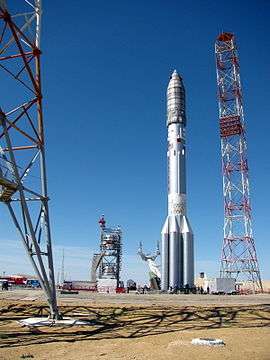
Proton-M on the launch pad
A heavy-lift launch vehicle, or HLV or HLLV, is an orbital launch vehicle capable of lifting between 20,000 to 50,000 kg to low Earth orbit.[1] The current heavy-lift launch vehicles in service are the Ariane 5 in its ES and ECA variants, the Russian Proton-M, the Chinese Long March 5, and the United Launch Alliance Delta IV Heavy.[2]
Heavy lift launch vehicles
Currently operational heavy-lift launch vehicles include:
- Ariane 5 ECA & ES 1996 to present - European Space Agency (ESA) 21,000 kg (46,000 lb)[3]
- Delta IV Heavy 2004 to present - World's highest capacity rocket currently in operation. Payload to LEO 28,790 kg (63,470 lb).[4]
- Long March 5 (CZ-5) 2016 to present - China Academy of Launch Vehicle Technology.[5] Payload to LEO 25,000 kg (55,115 lb).
- Proton-M 2001 to present - Russian 21,600 kg (47,600 lb)[6]
Unproven HLLVs
The following HLLVs have not yet flown with a payload that would classify them as an HLLV:
- Angara A5 24,500 kg (54,000 lb)[7] (not yet flown with heavy payload)
- Falcon 9 FT 22,800 kg (50,300 lb)[8] in a non-reusable configuration - SpaceX (Other configurations are classified as a medium-lift launch vehicle since payload to LEO is under 20,000 kg)
Former HLLVs
The following HLLVs were operational:
- Saturn IB from Apollo 5 1968 (retired after 9 launches) 21,000 kg (46,000 lb) [9]
- Titan IV 1989 to 2005 (retired after successful 35 launches) 21,680 kg (47,800 lb) [10]
- Space Shuttle 1981 to 2011 (retired after 135 launches) 24,400 kg (53,800 lb) of cargo bay payload only. [11]
In development
Four HLLVs are currently being developed:
- Vulcan - United Launch Alliance[12]
- Ariane 6 - European Space Agency[13]
- Falcon Heavy in a partially reusable configuration - SpaceX (Other configurations are classified as a super heavy-lift launch vehicle since payload to LEO is over 50,000 kg)
- New Glenn - Blue Origin
Earlier concepts
See also
- Sounding rocket non orbiting.
- Small-lift launch vehicle capable of lifting up to 2,000 kg to low Earth orbit.
- Medium-lift launch vehicle capable of lifting between 2,000 and 20,000 kg (4,400 to 44,100 lb) of payload into Low Earth orbit.
- Super heavy-lift launch vehicle capable of lifting more than 50,000 kg (110,000 lb) of payload into Low Earth orbit.
- Comparison of orbital launch systems
- Comparison of orbital rocket engines
- Comparison of space station cargo vehicles
- Rocket
- Spacecraft propulsion
References
- ↑ NASA Space Technology Roadmaps - Launch Propulsion Systems, p.11: "Small: 0-2t payloads, Medium: 2-20t payloads, Heavy: 20-50t payloads, Super Heavy: >50t payloads"
- ↑ NASA, Aug. 27, 2014, What Is a Heavy Lift Launch Vehicle?
- ↑ "Ariane 5 Users Manual, Issue 4, P. 39 (ISS orbit)" (PDF). Arianespace. Archived from the original (PDF) on 2007-09-27. Retrieved 2007-11-13.
- ↑ Delta IV Launch Services User’s Guide, June 2013
- ↑ Space launch report, CZ-5-7 Data Sheet
- ↑ "Proton Launch System Mission Planner's Guide, LKEB-9812-1990" (PDF). International Launch Services. pp. 2–2. Archived from the original on 2007-10-27. Retrieved 2007-11-12.
LEO i = 51.6°, H = 200 km circular ... GTO (1800 m/s from GSO) i = 31.0°, Hp = 2100 km, Ha = 35,786 km
- ↑ Spaceflight101, Angara-a5
- ↑ Capabilities & Services (2016)
- ↑ Entering the Race to the Moon, Saturn IB Established Its Place in Space.
- ↑ astronautix.com, Titan IV
- ↑ astronautix.com, Space Shuttle
- ↑ Space Flight Now, ULA unveils its future with the Vulcan rocket family, April 13, 2015, by Justin Ray
- ↑ "Ariane 6 design finalized, set for 2020 launch". Space Daily. 28 January 2016. Retrieved 30 January 2016.
- ↑ "Constellation Is Dead, But Pieces Live On". Aviation Week, October 26, 2010.
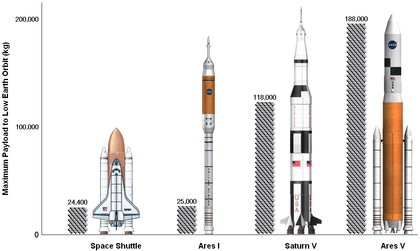
Comparison of maximum payload to low Earth orbit (LEO) (Left to right). Space Shuttle payload includes 7 crew and cargo. Ares I payload includes 4 crew and inherent craft. Saturn V payload includes 3 crew, inherent craft and cargo. Ares V payload includes only cargo and inherent craft. The Saturn V was capable of lifting approximately 140 metric tons of payload to LEO. The Ares V was being designed to lift 188 metric tons to LEO.
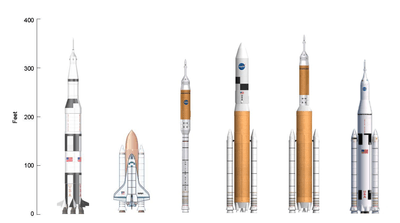
Comparison of Saturn V, Shuttle, Ares I, Ares V, Ares IV, and SLS Block I
Further reading
- Mallove, Eugene F. and Matloff, Gregory L. The Starflight Handbook: A Pioneer's Guide to Interstellar Travel, Wiley. ISBN 0-471-61912-4.
This article is issued from Wikipedia - version of the 11/7/2016. The text is available under the Creative Commons Attribution/Share Alike but additional terms may apply for the media files.