HMAS Echuca
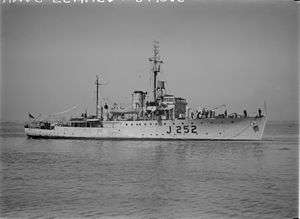 | |
| History | |
|---|---|
 Australia Australia | |
| Namesake: | Town of Echuca, Victoria |
| Builder: | HMA Naval Dockyard |
| Laid down: | 22 February 1941 |
| Launched: | 17 January 1942 |
| Commissioned: | 7 September 1942 |
| Decommissioned: | August 1946 |
| Recommissioned: | January 1947 |
| Decommissioned: | 28 June 1948 |
| Honours and awards: |
|
| Fate: | Transferred to RNZN |
| New Zealand | |
| Acquired: | 5 March 1952 |
| Commissioned: | May 1952 |
| Decommissioned: | April 1953 into reserve |
| Fate: | Sold for scrap 11 April 1967 |
| General characteristics | |
| Class and type: | Bathurst-class corvette |
| Displacement: |
|
| Length: | 186 ft (57 m) |
| Beam: | 31 ft (9.4 m) |
| Draught: | 8.5 ft (2.6 m) |
| Propulsion: | triple expansion engine, 2 shafts, 2,000 ihp |
| Speed: | 15 knots (28 km/h; 17 mph) at 1,750 hp |
| Complement: | 85 |
| Armament: |
|
HMAS Echuca (J252/M252), named for the town of Echuca, Victoria, was one of 60 Bathurst-class corvettes constructed during World War II, and one of 36 initially manned and commissioned by the Royal Australian Navy (RAN).[1]
Design and construction
In 1938, the Australian Commonwealth Naval Board (ACNB) identified the need for a general purpose 'local defence vessel' capable of both anti-submarine and mine-warfare duties, while easy to construct and operate.[2][3] The vessel was initially envisaged as having a displacement of approximately 500 tons, a speed of at least 10 knots (19 km/h; 12 mph), and a range of 2,000 nautical miles (3,700 km; 2,300 mi)[4] The opportunity to build a prototype in the place of a cancelled Bar-class boom defence vessel saw the proposed design increased to a 680-ton vessel, with a 15.5 knots (28.7 km/h; 17.8 mph) top speed, and a range of 2,850 nautical miles (5,280 km; 3,280 mi), armed with a 4-inch gun, equipped with asdic, and able to fitted with either depth charges or minesweeping equipment depending on the planned operations: although closer in size to a sloop than a local defence vessel, the resulting increased capabilities were accepted due to advantages over British-designed mine warfare and anti-submarine vessels.[2][5] Construction of the prototype HMAS Kangaroo did not go ahead, but the plans were retained.[6] The need for locally built 'all-rounder' vessels at the start of World War II saw the "Australian Minesweepers" (designated as such to hide their anti-submarine capability, but popularly referred to as "corvettes") approved in September 1939, with 60 constructed during the course of the war: 36 (including Echuca) ordered by the RAN, 20 ordered by the British Admiralty but manned and commissioned as RAN vessels, and 4 for the Royal Indian Navy.[2][7][8][9][1]
Echuca was laid down by HMA Naval Dockyard at Williamstown, Victoria on 22 February 1941.[1] She was launched on 17 January 1942 by Lady Royle, wife of First Naval Member Sir Guy Royle, and commissioned into the RAN on 7 September 1942.[1]
Operational history
World War II
Echuca’s initial role was as an anti-submarine patrol and convoy escort vessel along the eastern Australia coast and in New Guinea waters.[1] She stayed in this role from October 1942 until August 1944, when she was ordered to Darwin and attached to the United States Seventh Fleet's Survey Group.[1] She performed survey duties until the end of World War II, when she was refitted with minesweeping gear in Brisbane and assigned to the 20th Minesweeping Flotilla.[1] The Flotilla was responsible for clearing minefields set up in the waters of Australia, New Guinea, New Britain, and the Solomon Islands.[1]
Echuca received the battle honours "Pacific 1942–44" and "New Guinea 1943–44" for her wartime service.[10][11]
Echuca was paid off into Reserve in August 1946, but recommissioned in January 1947 for mine clearance work in the Great Barrier Reef.[1] The corvette performed this duty until August 1947, and in November 1947 towed the decommissioned corvette HMAS Inverell to Sydney.[1] Echuca was decommissioned again in Fremantle on 29 June 1948. At the end of April 1952, the corvette was sailed to Melbourne.[1]
RNZN service
On 5 March 1952, Echuca and three other Bathurst-class corvettes (HMA Ships Inverell, Kiama, and Stawell) were transferred to the Royal New Zealand Navy (RNZN).[12] She was commissioned into the RNZN in May 1952, and received the prefix HMNZS.[13]
The corvette remained in service with the RNZN until 1967, although from 1953 she was classified as being in reserve.[1][13] She was sold to Pacific Scrap Limited of Auckland for scrapping[1] on 11 April 1967.
Citations
- 1 2 3 4 5 6 7 8 9 10 11 12 13 "HMAS Echuca". HMA Ship Histories. Sea Power Centre – Royal Australian Navy. Retrieved 27 September 2008.
- 1 2 3 Stevens, The Australian Corvettes, p. 1
- ↑ Stevens, A Critical Vulnerability, p. 103
- ↑ Stevens, A Critical Vulnerability, pp. 103–4
- ↑ Stevens, A Critical Vulnerability, pp. 103–5
- ↑ Stevens, A Critical Vulnerability, p. 104
- ↑ Stevens, A Critical Vulnerability, pp. 105, 148
- ↑ Donohue, From Empire Defence to the Long Haul, p. 29
- ↑ Stevens et al., The Royal Australian Navy, p. 108
- ↑ "Navy Marks 109th Birthday With Historic Changes To Battle Honours". Royal Australian Navy. 1 March 2010. Archived from the original on 13 June 2011. Retrieved 23 December 2012.
- ↑ "Royal Australian Navy Ship/Unit Battle Honours" (PDF). Royal Australian Navy. 1 March 2010. Archived from the original (PDF) on 14 June 2011. Retrieved 23 December 2012.
- ↑ "HMAS Inverell (I)". HMA Ship Histories. Sea Power Centre – Royal Australian Navy. Retrieved 27 September 2008.
- 1 2 Gillett, Ross (1988). Australian and New Zealand Warships since 1946. Brookvale, NSW: Child & Associates. p. 140. ISBN 0-86777-219-0. OCLC 23470364.
References
Books
- Donohue, Hector (October 1996). From Empire Defence to the Long Haul: post-war defence policy and its impact on naval force structure planning 1945–1955. Papers in Australian Maritime Affairs. No. 1. Canberra: Sea Power Centre. ISBN 0-642-25907-0. ISSN 1327-5658. OCLC 36817771.
- Stevens, David (2005). A Critical Vulnerability: the impact of the submarine threat on Australia's maritime defense 1915–1954. Papers in Australian Maritime Affairs. No. 15. Canberra: Sea Power Centre Australia. ISBN 0-642-29625-1. ISSN 1327-5658. OCLC 62548623.
- Stevens, David; Sears, Jason; Goldrick, James; Cooper, Alastair; Jones, Peter; Spurling, Kathryn, (2001). Stevens, David, ed. The Royal Australian Navy. The Australian Centenary History of Defence (vol III). South Melbourne, VIC: Oxford University Press. ISBN 0-19-554116-2. OCLC 50418095.
Journal and news articles
- Stevens, David (May 2010). "The Australian Corvettes" (PDF). Hindsight (Semaphore). Sea Power Centre – Australia. 2010 (05). Retrieved 13 August 2010.
External links
 |
Wikimedia Commons has media related to HMAS Echuca (ship, 1942). |
| |||||||||||||||||||||