HMS Sturgeon (1894)
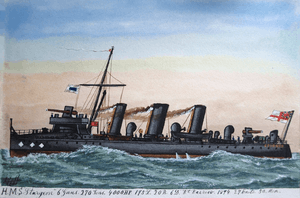 A watercolour of Sturgeon c. 1901 | |
| History | |
|---|---|
 United Kingdom United Kingdom | |
| Name: | HMS Sturgeon |
| Builder: | Vickers |
| Launched: | 1894 |
| Fate: | Sold, 1910 |
| General characteristics | |
| Class and type: | Sturgeon-class destroyer |
| Propulsion: | Blechynden boilers, 4,000 hp (2,983 kW) |
| Speed: | 27 knots (50 km/h; 31 mph) |
| Complement: | 53 |
| Armament: |
|
HMS Sturgeon was the lead ship of the Sturgeon-class destroyers which served with the Royal Navy. Built by Vickers, she was launched in 1894 and sold in 1910.
Construction and design
On 8 November 1893, the British Admiralty placed an order with the Naval Construction and Armament Company of Barrow-in-Furness (later to become part of Vickers) for three "Twenty-Seven Knotter" destroyers as part of the 1893–1894 construction programme for the Royal Navy,[1] with in total, 36 destroyers being ordered from various shipbuilders for this programme.[2]
The Admiralty only laid down a series of broad requirements for the destroyers, leaving detailed design to the ships' builders. The requirements included a trial speed of 27 knots (31 mph; 50 km/h), a "turtleback" forecastle and a standard armament of a QF 12 pounder 12 cwt (3 in (76 mm) calibre) gun on a platform on the ship's conning tower (in practice the platform was also used as the ship's bridge), with a secondary armament of five 6-pounder guns, and two 18-inch (450 mm) torpedo tubes.[3][4][5]
The Naval Construction and Armament Company produced a design with a length of 194 feet 6 inches (59.28 m) overall and 190 feet (57.91 m) between perpendiculars, with a beam of 19 feet (5.79 m) and a draught of 7 feet 7 inches (2.31 m). Displacement was 300 long tons (300 t) light and 340 long tons (350 t) deep load.[1] Three funnels were fitted, with the foremast between the ship's bridge and the first funnel.[6][7] Four Blechyndnen water-tube boilers fed steam at 200 pounds per square inch (1,400 kPa) to two three-cylinder triple expansion steam engines rated at 4,000 indicated horsepower (3,000 kW).[1][8] 60 tons of coal were carried,[9] giving a range of 1,370 nautical miles (2,540 km; 1,580 mi) at a speed of 11 knots (20 km/h; 13 mph).[10] The ship's crew was 53 officers and men.[10]
Service
Sturgeon served in home waters. In 1899-1900 she served in the Medway Instructional Flotilla,[11] but left this for other service in late 1900. The following year she again took up with the Medway instructional flotilla, replacing Mallard.[12] She had a refit in early 1902.[13] In May 1902 she received the officers and men from the destroyer Stag, and was again commissioned at Chatham on 8 May by Lieutenant John Maxwell D. E. Warren for service with the Flotilla.[14][15]
Notes
- 1 2 3 Lyon 2001, p. 69.
- ↑ Lyon 2001, p. 19.
- ↑ Lyon 2001, p. 20.
- ↑ Lyon 2001, pp. 98–99.
- ↑ Friedman 2009, p. 40.
- ↑ Friedman 2009, p. 50.
- ↑ Manning 1961, p. 38.
- ↑ The Engineer 11 October 1895, p. 365.
- ↑ Brassey 1902, p. 274.
- 1 2 Friedman 2009, p. 291.
- ↑ "Naval & Military intelligence". The Times (36052). London. 30 January 1900. p. 11.
- ↑ "Naval & Military intelligence". The Times (36581). London. 9 October 1901. p. 8.
- ↑ "Naval & Military intelligence". The Times (36773). London. 21 May 1902. p. 10.
- ↑ "Naval & Military intelligence". The Times (36761). London. 7 May 1902. p. 10.
- ↑ "Naval & Military intelligence". The Times (36768). London. 15 May 1902. p. 7.
References
- Brassey, T.A. (1902). The Naval Annual 1902. Portsmouth, UK: J. Griffin and Co.
- Friedman, Norman (2009). British Destroyers: From Earliest Days to the Second World War. Barnsley, UK: Seaforth Publishing. ISBN 978-1-84832-049-9.
- Layman, R. D. (1994). "Naval Kite Trials". In Roberts, John. Warship 1994. London: Conway Maritime Press. pp. 35–51. ISBN 0-85177-630-2.
- Lyon, David (2001). The First Destroyers. London: Caxton Editions. ISBN 1-84067-3648.
- Manning, Captain T.D. (1961). The British Destroyer. Putnam and Co.
- Manning, Captain T.D. The British Destroyer. Godfrey Cave Associates. ISBN 0-906223-13-X.
- "Speed Trials of the Torpedo Boat Destroyer Starfish" (PDF). The Engineer. Vol. 80. 11 October 1895. p. 365.