HSPA4
| HSPA4 | |||||||||||||||||
|---|---|---|---|---|---|---|---|---|---|---|---|---|---|---|---|---|---|
| Identifiers | |||||||||||||||||
| Aliases | HSPA4, APG-2, HEL-S-5a, HS24/P52, HSPH2, RY, hsp70, hsp70RY, heat shock protein family A (Hsp70) member 4 | ||||||||||||||||
| External IDs | MGI: 1342292 HomoloGene: 1624 GeneCards: HSPA4 | ||||||||||||||||
| |||||||||||||||||
| RNA expression pattern | |||||||||||||||||
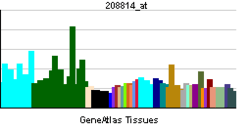  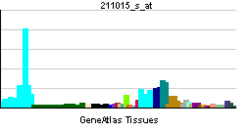 | |||||||||||||||||
| More reference expression data | |||||||||||||||||
| Orthologs | |||||||||||||||||
| Species | Human | Mouse | |||||||||||||||
| Entrez | |||||||||||||||||
| Ensembl | |||||||||||||||||
| UniProt | |||||||||||||||||
| RefSeq (mRNA) | |||||||||||||||||
| RefSeq (protein) |
| ||||||||||||||||
| Location (UCSC) | Chr 5: 133.05 – 133.11 Mb | Chr 11: 53.26 – 53.3 Mb | |||||||||||||||
| PubMed search | [1] | [2] | |||||||||||||||
| Wikidata | |||||||||||||||||
| View/Edit Human | View/Edit Mouse |
Heat shock 70 kDa protein 4 is a protein that in humans is encoded by the HSPA4 gene.[3][4]
The protein encoded by this gene was originally suggested to be a member of the heat shock protein 70 family.[3] However it is now known that human HSPA4 is an equivalent to mouse the Apg-2 protein and is a member of the Hsp110 family.[5]
Interactions
HSPA4 has been shown to interact with:
References
- ↑ "Human PubMed Reference:".
- ↑ "Mouse PubMed Reference:".
- 1 2 Fathallah DM, Cherif D, Dellagi K, Arnaout MA (Jul 1993). "Molecular cloning of a novel human hsp70 from a B cell line and its assignment to chromosome 5". Journal of Immunology. 151 (2): 810–3. PMID 8335910.
- ↑ "Entrez Gene: HSPA4 heat shock 70kDa protein 4".
- ↑ Kaneko Y, Kimura T, Kishishita M, Noda Y, Fujita J (Apr 1997). "Cloning of apg-2 encoding a novel member of heat shock protein 110 family". Gene. 189 (1): 19–24. doi:10.1016/S0378-1119(96)00807-4. PMID 9161406.
- ↑ Saleh A, Srinivasula SM, Balkir L, Robbins PD, Alnemri ES (Aug 2000). "Negative regulation of the Apaf-1 apoptosome by Hsp70". Nature Cell Biology. 2 (8): 476–83. doi:10.1038/35019510. PMID 10934467.
- 1 2 3 Oh WK, Song J (Aug 2003). "Cooperative interaction of Hsp40 and TPR1 with Hsp70 reverses Hsp70-HspBp1 complex formation". Molecules and Cells. 16 (1): 84–91. PMID 14503850.
- 1 2 Johnson CA, White DA, Lavender JS, O'Neill LP, Turner BM (Mar 2002). "Human class I histone deacetylase complexes show enhanced catalytic activity in the presence of ATP and co-immunoprecipitate with the ATP-dependent chaperone protein Hsp70". The Journal of Biological Chemistry. 277 (11): 9590–7. doi:10.1074/jbc.M107942200. PMID 11777905.
- ↑ Nair SC, Toran EJ, Rimerman RA, Hjermstad S, Smithgall TE, Smith DF (Dec 1996). "A pathway of multi-chaperone interactions common to diverse regulatory proteins: estrogen receptor, Fes tyrosine kinase, heat shock transcription factor Hsf1, and the aryl hydrocarbon receptor". Cell Stress & Chaperones. 1 (4): 237–50. doi:10.1379/1466-1268(1996)001<0237:apomci>2.3.co;2. PMC 376461
 . PMID 9222609.
 - ↑ Abravaya K, Myers MP, Murphy SP, Morimoto RI (Jul 1992). "The human heat shock protein hsp70 interacts with HSF, the transcription factor that regulates heat shock gene expression". Genes & Development. 6 (7): 1153–64. doi:10.1101/gad.6.7.1153. PMID 1628823.
- ↑ Anwar A, Siegel D, Kepa JK, Ross D (Apr 2002). "Interaction of the molecular chaperone Hsp70 with human NAD(P)H:quinone oxidoreductase 1". The Journal of Biological Chemistry. 277 (16): 14060–7. doi:10.1074/jbc.M111576200. PMID 11821413.
- ↑ Ballinger CA, Connell P, Wu Y, Hu Z, Thompson LJ, Yin LY, Patterson C (Jun 1999). "Identification of CHIP, a novel tetratricopeptide repeat-containing protein that interacts with heat shock proteins and negatively regulates chaperone functions". Molecular and Cellular Biology. 19 (6): 4535–45. doi:10.1128/mcb.19.6.4535. PMC 104411. PMID 10330192.
Further reading
- Abravaya K, Myers MP, Murphy SP, Morimoto RI (Jul 1992). "The human heat shock protein hsp70 interacts with HSF, the transcription factor that regulates heat shock gene expression". Genes & Development. 6 (7): 1153–64. doi:10.1101/gad.6.7.1153. PMID 1628823.
- Liao J, Lowthert LA, Ghori N, Omary MB (Jan 1995). "The 70-kDa heat shock proteins associate with glandular intermediate filaments in an ATP-dependent manner". The Journal of Biological Chemistry. 270 (2): 915–22. doi:10.1074/jbc.270.2.915. PMID 7529764.
- Furlini G, Vignoli M, Re MC, Gibellini D, Ramazzotti E, Zauli G, La Placa M (Jan 1994). "Human immunodeficiency virus type 1 interaction with the membrane of CD4+ cells induces the synthesis and nuclear translocation of 70K heat shock protein". The Journal of General Virology. 75 (1): 193–9. doi:10.1099/0022-1317-75-1-193. PMID 7906708.
- Bonaldo MF, Lennon G, Soares MB (Sep 1996). "Normalization and subtraction: two approaches to facilitate gene discovery". Genome Research. 6 (9): 791–806. doi:10.1101/gr.6.9.791. PMID 8889548.
- Schulte AM, Fischer S, Sachse GE, Häfner S, Stelck S, Gassen HG (Mar 1997). "Identification and characterization of a novel hsc70-like gene in the human lung tumor cell line HS24". DNA and Cell Biology. 16 (3): 257–68. doi:10.1089/dna.1997.16.257. PMID 9115634.
- Kaneko Y, Kimura T, Kishishita M, Noda Y, Fujita J (Apr 1997). "Cloning of apg-2 encoding a novel member of heat shock protein 110 family". Gene. 189 (1): 19–24. doi:10.1016/S0378-1119(96)00807-4. PMID 9161406.
- Bruner KL, Derfoul A, Robertson NM, Guerriero G, Fernandes-Alnemri T, Alnemri ES, Litwack G (1998). "The unliganded mineralocorticoid receptor is associated with heat shock proteins 70 and 90 and the immunophilin FKBP-52". Receptors & Signal Transduction. 7 (2): 85–98. PMID 9392437.
- Satyal SH, Chen D, Fox SG, Kramer JM, Morimoto RI (Jul 1998). "Negative regulation of the heat shock transcriptional response by HSBP1". Genes & Development. 12 (13): 1962–74. doi:10.1101/gad.12.13.1962. PMC 316975. PMID 9649501.
- Naylor DJ, Stines AP, Hoogenraad NJ, Høj PB (Aug 1998). "Evidence for the existence of distinct mammalian cytosolic, microsomal, and two mitochondrial GrpE-like proteins, the Co-chaperones of specific Hsp70 members". The Journal of Biological Chemistry. 273 (33): 21169–77. doi:10.1074/jbc.273.33.21169. PMID 9694873.
- Melville MW, Tan SL, Wambach M, Song J, Morimoto RI, Katze MG (Feb 1999). "The cellular inhibitor of the PKR protein kinase, P58(IPK), is an influenza virus-activated co-chaperone that modulates heat shock protein 70 activity". The Journal of Biological Chemistry. 274 (6): 3797–803. doi:10.1074/jbc.274.6.3797. PMID 9920933.
- Ballinger CA, Connell P, Wu Y, Hu Z, Thompson LJ, Yin LY, Patterson C (Jun 1999). "Identification of CHIP, a novel tetratricopeptide repeat-containing protein that interacts with heat shock proteins and negatively regulates chaperone functions". Molecular and Cellular Biology. 19 (6): 4535–45. doi:10.1128/mcb.19.6.4535. PMC 104411. PMID 10330192.
- Liu H, Vuyyuru VB, Pham CD, Yang Y, Singh B (Jun 1999). "Evidence of an interaction between Mos and Hsp70: a role of the Mos residue serine 3 in mediating Hsp70 association". Oncogene. 18 (23): 3461–70. doi:10.1038/sj.onc.1202699. PMID 10376524.
- Nonoguchi K, Itoh K, Xue JH, Tokuchi H, Nishiyama H, Kaneko Y, Tatsumi K, Okuno H, Tomiwa K, Fujita J (Sep 1999). "Cloning of human cDNAs for Apg-1 and Apg-2, members of the Hsp110 family, and chromosomal assignment of their genes". Gene. 237 (1): 21–8. doi:10.1016/S0378-1119(99)00325-X. PMID 10524232.
- O'Keeffe B, Fong Y, Chen D, Zhou S, Zhou Q (Jan 2000). "Requirement for a kinase-specific chaperone pathway in the production of a Cdk9/cyclin T1 heterodimer responsible for P-TEFb-mediated tat stimulation of HIV-1 transcription". The Journal of Biological Chemistry. 275 (1): 279–87. doi:10.1074/jbc.275.1.279. PMID 10617616.
- Agostini I, Popov S, Li J, Dubrovsky L, Hao T, Bukrinsky M (Sep 2000). "Heat-shock protein 70 can replace viral protein R of HIV-1 during nuclear import of the viral preintegration complex". Experimental Cell Research. 259 (2): 398–403. doi:10.1006/excr.2000.4992. PMID 10964507.
- Kim M, Jiang LH, Wilson HL, North RA, Surprenant A (Nov 2001). "Proteomic and functional evidence for a P2X7 receptor signalling complex". The EMBO Journal. 20 (22): 6347–58. doi:10.1093/emboj/20.22.6347. PMC 125721. PMID 11707406.
- Johnson CA, White DA, Lavender JS, O'Neill LP, Turner BM (Mar 2002). "Human class I histone deacetylase complexes show enhanced catalytic activity in the presence of ATP and co-immunoprecipitate with the ATP-dependent chaperone protein Hsp70". The Journal of Biological Chemistry. 277 (11): 9590–7. doi:10.1074/jbc.M107942200. PMID 11777905.
- Gurer C, Cimarelli A, Luban J (May 2002). "Specific incorporation of heat shock protein 70 family members into primate lentiviral virions". Journal of Virology. 76 (9): 4666–70. doi:10.1128/JVI.76.9.4666-4670.2002. PMC 155079. PMID 11932435.
- Freeman BC, Yamamoto KR (Jun 2002). "Disassembly of transcriptional regulatory complexes by molecular chaperones". Science. 296 (5576): 2232–5. doi:10.1126/science.1073051. PMID 12077419.
External links
- HSPA4 protein, human at the US National Library of Medicine Medical Subject Headings (MeSH)
This article is issued from Wikipedia - version of the 5/20/2016. The text is available under the Creative Commons Attribution/Share Alike but additional terms may apply for the media files.