Hanshin 9000 series
| Hanshin 9000 series | |
|---|---|
|
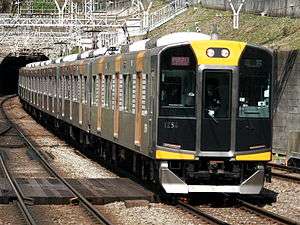
Set 9201 on the Kintetsu Nara Line in May 2008 | |
| In service | 1996 – Present |
| Manufacturer | Kawasaki Heavy Industries |
| Number built | 30 vehicles (5 sets) |
| Number in service | 30 vehicles (5 sets) |
| Formation | 6 cars per trainset |
| Fleet numbers | 9201 - 9209 |
| Capacity | 122 per car |
| Operator(s) | Hanshin Electric Railway |
| Line(s) served | |
| Specifications | |
| Car body construction | Stainless steel |
| Car length | 18,980 mm (62 ft 3 in) (end cars), 18,880 mm (61 ft 11 in) (intermediate cars) |
| Width | 2,800 mm (9 ft 2 in) |
| Height | 4,060 mm (13 ft 4 in) (end cars), 4,160 mm (13 ft 8 in) (intermediate cars) |
| Doors | 3 pairs per side |
| Maximum speed | 110 km/h (70 mph) |
| Traction system | Variable frequency (GTO) |
| Power output | 110 kW per motor |
| Acceleration | 4.0 km/h/s |
| Deceleration |
4.5 km/h/s (service) 5.0 km/h/s (emergency) |
| Electric system(s) | 1,500 V DC |
| Current collection method | Overhead catenary |
| Braking system(s) | Regenerative brake, electronically controlled pneumatic brakes |
| Safety system(s) | Hanshin ATS |
| Coupling system | Shibata-type |
| Multiple working | 1000 series |
| Track gauge | 1,435 mm (4 ft 8 1⁄2 in) |

The Hanshin 9000 series (阪神電鉄9000系 Hanshin Dentetsu 9000-kei) is a commuter electric multiple unit (EMU) train type operated by the private railway operator Hanshin Electric Railway in Japan since 1996.[1]
Design
The 9000 series was designed and built by Kawasaki Heavy Industries following the January 1995 Great Hanshin earthquake to replace vehicles damaged by the earthquake.[1] The 9000 series uses a stainless steel design for its body work.[1]
Operations
The 9000 series are able to operate in multiple with the newer 1000 series.[1]
Formation
As of 1 April 2016, five six-car sets (numbered 9201 to 9209) are in service, formed as shown below, with car 1 at the Umeda end. Four cars are powered.[2]
| Car No. | 1 | 2 | 3 | 4 | 5 | 6 |
|---|---|---|---|---|---|---|
| Designation | Tc1 | M1' | M | M | M' | Tc2 |
| Numbering | 92xx (odd) | 90xx (odd) | 91xx (odd) | 91xx (even) | 90xx (even) | 92xx (even) |
| Capacity Total |
122 | 132 | 132 | 132 | 132 | 122 |
Cars 3 and 4 each have one lozenge-style pantograph.[2]
Interior
Passenger accommodation consists of longitudinal bench seating throughout.[1]
History
 Set 9205 in original livery in July 2007
References
- 1 2 3 4 5 私鉄車両年鑑2013 [Japan Private Railways Annual 2013] (in Japanese). Tokyo, Japan: Ikaros Publications Ltd. 20 March 2013. p. 92. ISBN 978-4-86320-693-9.
- 1 2 私鉄車両編成表 2016 [Private Railway Rolling Stock Formations - 2016] (in Japanese). Japan: Kotsu Shimbunsha. 25 July 2016. p. 146. ISBN 978-4-330-70116-5.
External links
 |
Wikimedia Commons has media related to Hanshin 9000 series. |
- Hanshin Electric Railway train information (Japanese)
Hanshin trainsets | ||
|---|---|---|
| Limited Express/Express |
|  |
| Commuter |
| |