Hari Uppal
| Hari Uppal | |
|---|---|
| Born |
22 September 1926 Manpur, Samastipur district, Bihar, India |
| Died |
2 January 2011 Kolkata, India |
| Resting place |
Magra, Nalanda, Bihar, India 25°07′12″N 85°18′40″E / 25.1200°N 85.3112°E |
| Children |
Abhik Uppal Stella Uppal Subbiah and two other daughters |
| Awards |
Padma Shri Sangeet Natak Akademi Award Tamra Patra |
| Website | Official web site |
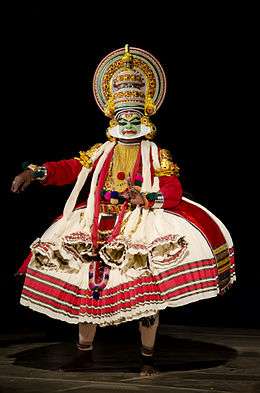
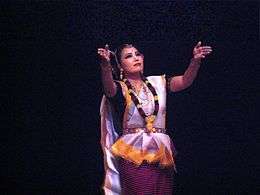
Hari Uppal (1926–2011) was an Indian classical dancer[1][2][3][4][5] and the founder of a classical dance academy by name, Bhartiya Nritya Kala Mandir, [6] known for his expertise in the dance forms of Kathakali and Manipuri.[7][8] He was honored by the Government of India, in 2010, with the fourth highest Indian civilian award of Padma Shri.[9]
Biography
Hari Uppal was born on 22 September 1926 [2][5][8] in Manpur in Samastipur district in the Indian state of Bihar.[6][3] He did his schooling at a local school in Patna and graduated from Patna Arts College in Sculpture.[8] Receiving a scholarship, Uppal joined Shantiniketan in 1943, from where he learnt Kathakali and Manipuri dance.[6][8] The next move was to Kerala Kalamandalam and studied under the tutelage of the renowned Kathakali exponent, Guru Kunchu Kurup and Asan Ramankutty Nair.[8] This was followed by a training stint on Raas Maharas and Basant Raas styles of Manipuri dance under the guidance of Guru Ojha Amubi Singh, in 1949.[8] He has also had a three months training on European Folk dances in Czechoslovakia and Russia, on a scholarship from the Government of India, in 1970.[6][8]
On 8 December 1950, Uppal started working on his project, Bhartiya Nritya Kala Mandir, a dance academy of modest proportions.[6][7] The academy, which started in 1963, with a student strength of 8 boys and 10 girls,[6][8] have grown over the years to include coaching for five Indian classical dance forms and several fork dance forms of Bihar. The academy hosts studios for dance and drama, a gallery and an art museum[10][11] and has training centres in Patna and Ranchi.[3] It has also gained the status of a Music College since 2011.[12]
Hari Uppal died on 2 January 2011 at a hospital in Kolkata, reportedly due to Cerebral hemorrhage.[1][3] leaving behind his son, Abhik, and three daughters.[1][7] Stella Uppal Subbiah, one of his daughters, is an alumnus of Kalakshetra of Rukmini Devi Arundale, and a UK based known exponent of Bharatanatyam.[13] His mortal remains were laid to rest at Uppal House, his residence in Magra in the district of Nalanda, Bihar.[1][7][4]
Awards and recognitions
Hari Uppal received the Tamra Patra (Copper Plaque) from the Bihar Nritya Natya Kala Parishad in 1952[6] and the Sangeet Natak Akademi Award in 2001.[2][7][14] The Government of India included him in the 2010 Republic Day honours list, for the civilian award of Padma Shri.[6][9]
See also
References
- 1 2 3 4 "TOI". TOI. January 3, 2011. Retrieved December 19, 2014.
- 1 2 3 "Oxford Index". Oxford University Press. 2014. Retrieved December 19, 2014.
- 1 2 3 4 "Bihar Times". Bihar Times. 2011. Retrieved December 19, 2014.
- 1 2 "Indian Express". Indian Express. 3 January 2011. Retrieved December 19, 2014.
- 1 2 Saṅgīt Mahābhāratī (2011). The Oxford Encyclopaedia of the Music of India. Oxford University Press. ISBN 9780195650983.
- 1 2 3 4 5 6 7 8 "Telegraph". Telegraph. 4 January 2011. Retrieved December 19, 2014.
- 1 2 3 4 5 "Patna Daily". Patna Daily. 3 January 2011. Retrieved December 19, 2014.
- 1 2 3 4 5 6 7 8 "Bihar Days". Bihar Days. 4 January 2011. Retrieved December 19, 2014.
- 1 2 "Padma Shri" (PDF). Padma Shri. 2014. Retrieved November 11, 2014.
- ↑ "TOI BNKM". TOI. 15 March 2013. Retrieved December 19, 2014.
- ↑ "Bihar Plus". Bihar Plus. 2014. Retrieved December 19, 2014.
- ↑ "Music College". TOI. April 10, 2011. Retrieved December 19, 2014.
- ↑ "Red Hot Curry". Red Hot Curry. 2014. Retrieved December 19, 2014.
- ↑ "Sangeet Natak Akademi". Sangeet Natak Akademi. 2014. Retrieved December 19, 2014.
External links
- "Economic Times". Economic Times. 2010. Retrieved December 18, 2014.