Hecatomnids
The Hecatomnid dynasty or Hecatomnids were the rulers of Caria and surrounding areas from about 395–334 BCE.
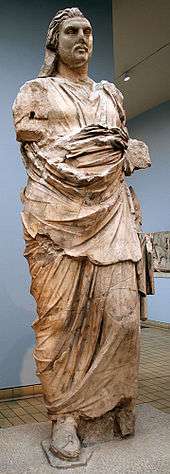
They were nominally satraps (governors) under the Persian Achaeminid Empire, but ruled with considerable autonomy, and established a hereditary dynasty. The dynasty was founded by Hecatomnus and originally had its seat in Mylasa; Mausolus moved it to Halicarnassus.
Hecatomnus' five children succeeded him in succession. The dynasty engaged in sibling marriage to presumably preserve royal power within the family.[1]
The dynasty ended with the conquests of Alexander the Great. Ada adopted him as her son, so that he would succeed to the rule of Caria.
The best-known monument of the dynasty is the Mausoleum that Artemisia II built in honor of her husband and brother Mausolus.
Members
- Hecatomnus, ruled 395–377
- Mausolus, son of Hecatomnus, ruled 377–353
- Artemisia II, daughter of Hecatomnus, wife of Mausolus, ruled 353–351
- Idrieus, son of Hecatomnus, ruled 351–344
- Ada, daughter of Hecatomnus, wife of Idrieus, ruled 344–340 and 334–326 (under Alexander the Great)
- Pixodarus, son of Hecatomnus, ruled 340–335
Bibliography
- Stephen Ruzicka, Politics of a Persian Dynasty: The Hecatomnids in the Fourth Century B.C. , University of Oklahoma Press, 1992, ISBN 0806124601 (not seen).
- Stephen Ruzicka, "The Hecatomnid Dynasty of Caria" (not seen) abstract
- "Hecatomnid dynasty" at livius.org
References
- ↑ "Women in Dunasteia in Caria". The American Journal of Philology. 126. Spring 2005.