2-Methyl-2,4-pentanediol
 | |
| Names | |
|---|---|
| IUPAC name
2-Methyl-2,4-pentanediol | |
| Other names
Hexylene glycol; Diolane; 1,1,3-Trimethyltrimethylenediol; 2,4-Dihydroxy-2-methylpentane; Isol | |
| Identifiers | |
107-41-5  99210-90-9 (R)  99210-91-0 (S) | |
| 3D model (Jmol) | Interactive image |
| Abbreviations | MPD |
| ChEBI | CHEBI:62995 |
| ChEMBL | ChEMBL2104293 |
| ChemSpider | 7582 |
| ECHA InfoCard | 100.003.173 |
| PubChem | 7870 |
| UNII | KEH0A3F75J |
| |
| |
| Properties | |
| C6H14O2 | |
| Molar mass | 118.18 g·mol−1 |
| Appearance | colourless liquid |
| Odor | mild, sweetish[1] |
| Density | 0.92 g/mL |
| Melting point | −40 °C (−40 °F; 233 K) |
| Boiling point | 197 °C (387 °F; 470 K) |
| miscible[1] | |
| Vapor pressure | 0.05 mmHg (20°C)[1] |
| Hazards | |
| Flash point | 98.3 °C (208.9 °F; 371.4 K) [2] |
| Explosive limits | 1.3%-7.4%[1] |
| US health exposure limits (NIOSH): | |
| PEL (Permissible) |
none[1] |
| REL (Recommended) |
C 25 ppm (125 mg/m3)[1] |
| IDLH (Immediate danger) |
N.D.[1] |
| Except where otherwise noted, data are given for materials in their standard state (at 25 °C [77 °F], 100 kPa). | |
| verify (what is ?) | |
| Infobox references | |
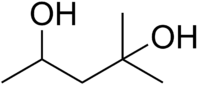
2-Methyl-2,4-pentanediol (MPD) is an organic compound with the formula (CH3)2C(OH)CH2CH(OH)CH3. This colourless liquid is a chiral diol. It is produced industrially from diacetone alcohol by hydrogenation.[3] Total European and USA production was 15000 tonnes in 2000.[4]
2-Methyl-2,4-pentanediol exists as two enantiomers, (4R)-(-) and (4S)-(+). In the Protein Data Bank, the 3-letter code "MPD" refers to the (S)-(-) enantiomer, while "MRD" is used to refer to the (R)-(+) version. Commercial products labeled "MPD" are usually the racemate,[5] also sold as and referred to as "hexylene glycol".[6][7]
Uses
2-Methyl-2,4-pentanediol exhibits both surfactant and emulsion-stabilizing properties. Its relatively high viscosity and low volatility are advantageous in coatings, cleansers, cosmetics, solvents, and hydraulic fluids.[8] Although it is an irritant at higher concentrations, It is sometimes used in skin care, hair care, soap, and eye cosmetic products at concentrations ranging from 0.1% - 25%.[9][10]
It is biodegradable and unlikely to accumulate in the environment.[11]
Laboratory uses
In the laboratory it is a common precipitant and cryoprotectant in protein crystallography.[12] Since hexylene glycol is compatible with polar and nonpolar molecules, it competes with the solvent in a crystallography experiment causing the protein to precipitate.[13] Hexylene glycol is so effective in protein crystallography because its amphiphilic nature and small, flexible structure allows it to bind to many different locations on a protein secondary structure including alpha helices and beta sheets.[14] When hexylene glycol binds to these different locations, water is removed and the protein crystals anneal, which prevents ice formation during cryocrystallography techniques.[15] Incorporation of hexylene glycol into solution has been known to improve the resolution of X-ray diffraction making protein structures easily identifiable.[16] Additionally hexylene glycol is not a strong denaturing agent and thus does not significantly alter the structure of a protein during the crystallography procedure.[14]
Like related diols, it forms borate esters.
References
- 1 2 3 4 5 6 7 "NIOSH Pocket Guide to Chemical Hazards #0328". National Institute for Occupational Safety and Health (NIOSH).
- ↑ CDC - NIOSH Pocket Guide to Chemical Hazards
- ↑ Stylianos Sifniades, Alan B. Levy, "Acetone" in Ullmann’s Encyclopedia of Industrial Chemistry, Wiley-VCH, Weinheim, 2005. doi:10.1002/14356007.a01_079.pub3
- ↑ SIDS Initial Assessment Report for SIAM 13: Hexylene Glycol
- ↑ MPD at Hampton Research , MPD Product Page
- ↑ Hexylene Glycol at Sigma Aldrich , Hexylene Glycol Product Page
- ↑ Hexylene Glycol at Jena Bioscience, Hexylene Glycol Product Page
- ↑ Chemicalland21.com Hexylene glycol
- ↑ Kinnunen, T. (1991). "Antibacterial and antifungal properties of propylene glycol, and 1,3-butylene glycol in vitro". Acta Dermato-venereologica.
- ↑ R. Rietschel; J. Fowler; A. Fisher Hexylene Glycol. In Fisher's Contact Dermatitis; Holmes, M., Ed.; BC Decker Inc.: Hamilton,Ontario, 2008; pp 290
- ↑ Rhodia Hexylene glycol GPS Safety Summary. 2012.
- ↑ Crystallization Techniques: Additives, Enrico Stura, University of Glasgow
- ↑ Dumetz, A. (2009). "Comparative Effects of Salt, Organic and Polymer Precipitants on Protein Phase Behavior and Implications for Vapor Diffusion". J. Cryst. Growth.
- 1 2 Anand, K (2002). "An overview on 2-methyl-2,4-pentanediol in crystallization and in crystals of biological macromolecules". Acta Crystallogr.
- ↑ Viatcheslav, Berejnov (2006). "Thornea Effects of cryoprotectant concentration and cooling rate on vitrification of aqueous solutions". J. Appl. Crystallography.
- ↑ Vera, L (2006). "Strategies for Protein Crystallography". Cryst. Growth Des.