Hygrophorus pudorinus
| Hygrophorus pudorinus | |
|---|---|
 | |
| Scientific classification | |
| Kingdom: | Fungi |
| Division: | Basidiomycota |
| Class: | Agaricomycetes |
| Order: | Agaricales |
| Family: | Hygrophoraceae |
| Genus: | Hygrophorus |
| Species: | H. pudorinus |
| Binomial name | |
| Hygrophorus pudorinus (Fr.) Fr., 1838 | |
| Synonyms | |
|
Agaricus pudorinus Fr. Limacium eburneum var. pudorinum (Fr.) P. Kumm. | |
Hygrophorus pudorinus, commonly known as the blushing waxycap[1] or turpentine waxycap,[2] is a species of fungus in the genus Hygrophorus.[3]
Swedish mycologist Elias Magnus Fries described it as Agaricus pudorinus in his 1821 work Systema Mycologicum.[4] It became Hygrophorus pudorinus with the raising of Hygrophorus to genus rank. The species name is the Latin word pudorinus "blushing".[5]
The species is classified in the subsection Pudorini of genus Hygrophorus, along with the closely related species H. erubescens and H. purpurascens.[6]
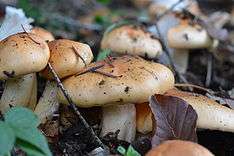
The fruit body (mushroom) is a fair size, with a 5–12 cm (2–4 3⁄4 in) diameter pink to golden convex cap with a downrolled margin that is lighter in colour. The cap surface is sticky. The pink to yellow-white gills are decurrent. The thick stipe is 4–9 cm (1 5⁄8–3 1⁄2 in) tall and 1–2 cm (3⁄8–3⁄4 in) wide. The spore print is white and the oval spores measure 7–10 × 5–6 micrometres. The thick flesh is pale pink or orange to white. The mushroom does not bruise red and has no distinctive odour, though it can taste like turpentine.[1]
Hygrophorus pudorinus is found in coniferous woodlands under fir and spruce trees[7] across western and northeastern North America;[1] it is particularly common in Canada[7] and the Rocky Mountains.[5] The mushrooms appear in groups or fairy rings in late summer and autumn.[1] They often grow in boggy places in sphagnum moss.[2]
Despite its taste, it is edible after cooking.[7] Its variable appearance makes identification difficult and hence raises risk of misidentification.[1]
References
- 1 2 3 4 5 McKnight KH, Peterson RT, McKnight VB (1998). A Field Guide to Mushrooms: North America. Houghton Mifflin Harcourt. p. 209. ISBN 9780395910900.
- 1 2 Bessette A, Bessette AR, Fischer DW (1997). Mushrooms of Northeastern North America. Syracuse University Press. p. 143. ISBN 978-0-8156-0388-7.
- ↑ "Hygrophorus pudorinus (Fr.) Fr.". MycoBank. International Mycological Association. Retrieved 1 November 2015.
- ↑ Fries EM. (1821). Systema Mycologicum (in Latin). 1. Lund: Ex Officina Berlingiana. p. 33.
- 1 2 Evenson VS. (1997). Mushrooms of Colorado and the Southern Rocky Mountains. Westcliffe Publishers. p. 68. ISBN 978-1-56579-192-3.
- ↑ Lodge DJ; et al. (2014). "Molecular phylogeny, morphology, pigment chemistry and ecology in Hygrophoraceae (Agaricales)". Fungal Diversity. 64 (1): 1–99 (see p. 64). doi:10.1007/s13225-013-0259-0.

- 1 2 3 States J (1990). Mushrooms and Truffles of the Southwest. University of Arizona Press. p. 66. ISBN 9780816511921.