Initial value theorem
In mathematical analysis, the initial value theorem is a theorem used to relate frequency domain expressions to the time domain behavior as time approaches zero.[1]
It is also known under the abbreviation IVT.
Let
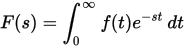
be the (one-sided) Laplace transform of ƒ(t). The initial value theorem then says[2]

Proof
Based on the definition of Laplace transform of derivative we have:

thus:
![\lim_{s \to \infty} sF(s)=\lim_{s \to \infty} [f(0^-)+\int_{t=0^-}^{\infty}e^{-st}f^{'}(t)dt]](../I/m/e7c742db03e376446034382179d70aef6d9ca424.svg)
But is indeterminate between t=0− to t=0+; to avoid this, the integration can be performed in two intervals:

![\lim_{s \to \infty} [\int_{t=0^-}^{\infty}e^{-st}f^{'}(t)dt]
=\lim_{s \to \infty}\{\lim_{\epsilon \to 0^+}[\int_{t=0^-}^{\epsilon}e^{-st}f^{'}(t)dt] + \lim_{\epsilon \to 0^+}[\int_{t=\epsilon}^{\infty}e^{-st}f^{'}(t)dt]\}](../I/m/aa60e11026a76e1ccacdda1c8a7ee05e5ad7fc4c.svg)
In the first expression,

In the second expression, the order of integration and limit-taking can be changed. Also

Therefore:[3]
![\begin{align}
\lim_{s \to \infty} [\int_{t=0^-}^{\infty}e^{-st}f^{'}(t)dt] &=\lim_{s \to \infty}\{\lim_{\epsilon \to 0^+}[\int_{t=0^-}^{\epsilon}f^{'}(t)dt]\} + \lim_{\epsilon \to 0^+}\{\int_{t=\epsilon}^{\infty}\lim_{s \to \infty}[e^{-st}f^{'}(t)dt]\}\\
&=f(t)|_{t=0^-}^{t=0^+} + 0\\
&= f(0^+)-f(0^-)+0\\
\end{align}](../I/m/1451d6db281761508d49219311cc43484742bf4e.svg)
By substitution of this result in the main equation we get:

See also
Notes
- ↑ http://fourier.eng.hmc.edu/e102/lectures/Laplace_Transform/node17.html
- ↑ Robert H. Cannon, Dynamics of Physical Systems, Courier Dover Publications, 2003, page 567.
- ↑ Robert H., Jr. Cannon (4 May 2012). Dynamics of Physical Systems. Courier Dover Publications. p. 569. ISBN 978-0-486-13969-2.
This article is issued from Wikipedia - version of the 11/2/2016. The text is available under the Creative Commons Attribution/Share Alike but additional terms may apply for the media files.