Iris graeberiana
| Iris graeberiana | |
|---|---|
 | |
| Scientific classification | |
| Kingdom: | Plantae |
| (unranked): | Angiosperms |
| (unranked): | Monocots |
| Order: | Asparagales |
| Family: | Iridaceae |
| Subfamily: | Iridoideae |
| Tribe: | Irideae |
| Genus: | Iris |
| Subgenus: | Scorpiris |
| Species: | Iris graeberiana |
| Binomial name | |
| Iris graeberiana Sealy | |
| Synonyms | |
| |
Iris graeberiana is a species in the genus Iris, in the subgenus of Scorpiris. It is a bulbous perennial.
It was named after Paul Graeber (a plant collector who also collected Iris hoogiana and Tulipa ostrowskiana for the Dutch Van Tubergen company).[2][3]
It was first published in Botanical Magazine 167: t. 126 by Sealy in 1950.[4]
Iris graeberiana is an accepted name by the RHS.[5]
It is hardy to USDA Zone 5-8.[6]
It can be seen growing in Le Grand Clos botanical garden in Bourgueil, France.[7]
Habit
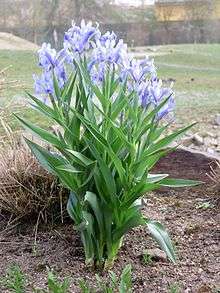
In late spring,[8](April).[9] It has between 4-6 flowers per stem and reaches a maximum height of 45cm (18") tall.[10]
It has pale silvery mauve flowers.[10] It also comes in blueish-lavender,[8] or blue-violet shades.[11] The flowers are 6-8cm (2.5-3in) wide with a wavy,[11] white crest on each fall.[8] Which is surrounded by a pale, boldly veined zone.[11]
The white margined leaves, have glossy mid-green tops, but with greyish green bottoms, which are scattered along the stem.[8] The leaves grow to approximately 20cm tall at flowering time, then they extend to twice this. They are between 1.5-3.5cm wide.[11]
It is known as one of the more vigorous species,[10] therefore is easier to grow the others in the subgenus.[8]
They are best grown in well drained soils [12] in open, stony places or an Alpine house, but some growers recommend outside culture if sheltered from heavy summer rains.[11]
Native
It is native to Tajikistan[13] and Turkestan (parts of the former republic of USSR) and Central Asia.[10]
Known hybrids
- Iris graeberiana 'White fall' [14]
It is thought to have been bred by crossing Iris graeberiana with Iris magnifica.[6]
- Iris graeberiana 'Yellow fall' [15]
- Iris graeberiana 'Dark Form'
A more hardy plant but with smaller darker flowers. It is similar to Iris zenaidae but with smaller flowers.[16]
References
- ↑ "Juno graeberiana". www.theplantlist.org. 23 March 2012. Retrieved 21 August 2014.
- ↑ Austin, Claire. "Irises A Garden Encyclopedia" (pdf). worldtracker.org. p. 287. Retrieved 21 July 2014.
- ↑ "Tulipa ostrowskiana". rareplants.co.uk. Retrieved 23 August 2014.
- ↑ "Iris graeberiana". apps.kew.org. Retrieved 21 August 2014.
- ↑ "Iris graeberiana". www.rhs.org.uk. Retrieved 21 August 2014.
- 1 2 "Iris graeberiana". www.signa.org (Species Iris Group of North America). Retrieved 23 August 2014.
- ↑ "irisbotanique".
- 1 2 3 4 5 Brickell, Christopher, ed. (1996). RHS Encyclopedia of Garden Plants. London: Dorling Kindersley. p. 522. ISBN 978-0-7513-0436-7.
- ↑ "How to grow Iris". www.backyardgardener.com. Retrieved 23 August 2014.
- 1 2 3 4 Cassidy, G.E.; Linnegar, S. (1987). Growing Irises (Revised ed.). Bromley: Christopher Helm. p. 145-146. ISBN 0-88192-089-4.
- 1 2 3 4 5 "Iris graeberiana". encyclopaedia.alpinegardensociety.net. Retrieved 23 August 2014.
- ↑ "flag". Retrieved 23 August 2014.
- ↑ "Tajikistan". lntreasures.com. Retrieved 23 August 2014.
- ↑ "Autumn List (G-L)". www.westonbirtplants.co.uk. 2007. Retrieved 19 August 2014.
- ↑ "PlantFiles: Juno, Scorpiris". Retrieved 23 August 2014.
- ↑ "Juno Irises (A-l)". www.pacificbulbsociety.org. Retrieved 23 August 2014.
Other sources
- Walter Erhardt, Erich Götz, Nils Bödeker, Siegmund Seybold: Der große Zander. Eugen Ulmer KG, Stuttgart 2008, ISBN 978-3-8001-5406-7. (Ger.)
- Mathew 1981 (J. McGary, 28-APR-04)
 Media related to Iris graeberiana at Wikimedia Commons
 Data related to Iris graeberiana at Wikispecies