Irreligion in Romania

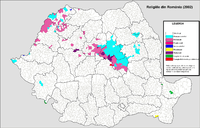
Religion in Romania as of 2011[1]
Although it is a secular state, in Romania there is no effective separation of church and state. Indeed, according to Law no. 142/1999, state-recognized religious denominations employees receive salaries from the state budget.[3] Therefore, all Romanian citizens who pay taxes contribute to clergy salaries, regardless of their religious affiliation.
Romania is one of the most religious countries in Europe,[4] with 92% of people saying that they believe in God.[5] Irreligion is much lower in Romania than in most other European countries and pretty much one of the lowest in the world. At the 2011 census, only 0.11% of the population declared itself atheist, up from the 2002 census, while 0.10% do not belong to any religion.[6]
Demographics
Over 20,700 people in Romania are atheists, according to 2011 census.[7] Thus, the number of Romanians who do not believe in God almost tripled in the previous decade.[8] The highest concentration is in Bucharest–Ilfov area (nearly 8,000 atheists) and generally wealthy areas of the country (Transylvania, Banat), the lowest – in Oltenia (750), Dobruja and poor areas of Wallachia (Teleorman, Călărași, Ialomița).[8] Before the census of October 2011, Secular Humanist Association (ASUR) conducted a campaign through which tried to promote an accurate census, in which people who consider themselves atheists to have confidence in selecting this option.[8] According to ASUR, European Values Survey (1999)[9] and World Values Survey (2005)[10] polls show that the real percentage of those who declare themselves atheists is at least 6–7% of the population, 60–70 times more than the result of census in 2002.[8] In The Cambridge Companion to Atheism (2006), Phil Zuckerman gives a figure of 4%.[11] A 2014 poll by WIN/Gallup International Association shows that 16% of Romanians are not religious and only 1% are convinced atheists.[12]
| Development region | Irreligious | Atheists | Total |
|---|---|---|---|
| București-Ilfov | 3,295 | 8,517 | 11,812 (0.51%) |
| Centru | 5,611 | 2,085 | 7,696 (0.32%) |
| Nord-Est | 1,213 | 1,629 | 2,842 (0.08%) |
| Nord-Vest | 4,622 | 3,098 | 7,720 (0.29%) |
| Sud-Est | 607 | 1,321 | 1,928 (0.07%) |
| Sud-Muntenia | 970 | 1,443 | 2,413 (0.07%) |
| Sud-Vest Oltenia | 380 | 525 | 905 (0.04%) |
| Vest | 2,219 | 2,125 | 4,344 (0.23%) |
| Total[13] | 18,917 | 20,743 | 39,660 |
Socio-demographic profile
According to a study conducted by researchers from the Soros Foundation, Romanian atheists are a very young group and with a significantly higher level of education that the national average: 53% of atheists are under 30 years, and 33% of them have completed higher education.[14] The group of atheists/agnostics/persons without religion lives in a proportion of 59% in urban areas – in the capital and other major cities – and are easier to find in Wallachia and harder in Moldavia.[14]
Atheists are more intolerant than most Romanians to almost all social groups on which were questioned: Roma, sectarians, Hungarians, Muslims, Jews, poor.[15] The only exception to this string of intolerance is represented by homosexuals, towards them atheists showing more tolerance than the national average.[15] As ideological positioning, atheists declare themselves, equally, both right-wing and left-wing, most of them (56%) placing at the center of the ideological line. Only eight percent say they prefer leftist economic policies, while right-wing economic policies attract 47% of atheists.[15]
References
- ↑ "Romania Demographics Profile 2014". IndexMundi.
- ↑ Special Eurobarometer 341 / Wave 73.1 – TNS Opinion & Social (PDF). Brussels. October 2010. p. 204.
- ↑ "Legea nr. 142/1999, legea privind sprijinul statului pentru salarizarea clerului". Drept Online.
- ↑ Tomka, Miklós (2011). Expanding Religion: Religious Revival in Post-communist Central and Eastern Europe. Walter de Gruyter. p. 75. ISBN 9783110228151.
- ↑ Tarta, Mihai (15 June 2015). "European Culture Wars: Sexual Nationalism between Euro-Christian and Euro-Secular Civil Religion in Poland and Romania". In Sremac, Srdjan; Ganzevoort, R. Ruard. Religious and Sexual Nationalisms in Central and Eastern Europe: Gods, Gays and Governments. Leiden: Brill. p. 33. ISBN 978-90-04-29779-1.
- ↑ "Ce ne spune recensământul din anul 2011 despre religie?" (PDF). Institutul Național de Statistică. October 2013.
- ↑ "Ateismul în România. Care sunt județele cu cei mai mulți atei". Gândul. 9 October 2013.
- 1 2 3 4 "Numarul ATEILOR s-a triplat. Cati romani au renuntat la religie?". 9AM. 5 December 2012.
- ↑ "Survey 1999". European Values Study. doi:10.4232/1.10789.
- ↑ "World Values Survey, 2005". The Association of Religion Data Archives.
- ↑ Phil Zuckerman (30 October 2006). "Contemporary Numbers and Patterns". The Cambridge Companion to Atheism. Cambridge University Press. p. 55. ISBN 9781139827393.
- ↑ "Regional & Country Results". WIN/Gallup International.
- ↑ "Religiile Romaniei. Orasul cu cel mai mare procent de atei din tara". InCont.ro.
- 1 2 "Ateii din Romania sunt tineri, educati si intoleranti". Ziare.com. 18 October 2011.
- 1 2 3 Ovidiu Voicu (18 October 2011). "Atei în România: puțini, tineri, educați, de dreapta și intoleranți" (PDF). Fundația Soros.