Isaac Namioka
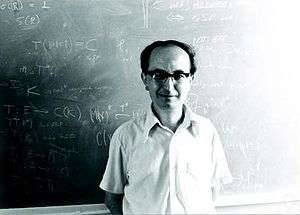
Isaac Namioka (born April 25, 1928)[1] is a Japanese-American mathematician who has worked in general topology and functional analysis. He is a professor emeritus of mathematics at the University of Washington.[2]
Early life and education
Namioka was born in Tōno, not far from Namioka in the north of Honshu, Japan. When he was young his parents moved farther south, to Himeji.[3] He attended graduate school at the University of California, Berkeley, earning a doctorate in 1956 under the supervision of John L. Kelley.[4] As a graduate student, Namioka married Chinese-American mathematics student Lensey Namioka, later to become a well-known novelist who used Namioka's Japanese heritage in some of her novels.[3]
Career
Namioka taught at Cornell University until 1963, when he moved to the University of Washington.[1] There he was the doctoral advisor to four students. He has over 20 academic descendants, largely through his student Joseph Rosenblatt, who became a professor at the University of Illinois at Urbana–Champaign.[4]
Contributions
Namioka's book Linear Topological Spaces with Kelley has become a "standard text".[1] However, although his doctoral work and this book both concerned general topology, his interests later shifted to functional analysis.[5]
With Asplund in 1967, Namioka gave one of the first complete proofs of the Ryll-Nardzewski fixed-point theorem.[6]
Following his 1974 paper "separate continuity and joint continuity", a Namioka space has come to mean a topological space X with the property that whenever Y is a compact space and function f from the Cartesian product of X and Y to Z is separately continuous in X and Y, there must exist a dense Gδ set within X whose Cartesian product with Y is a subset of the set of points of continuity of f.[7][8] The result of the 1974 paper, a proof of this property for a specific class of topological spaces, has come to be known as Namioka's theorem.[9]
In 1975, Namioka and Phelps established one side of the theorem that a space is an Asplund space if and only if its dual space has the Radon–Nikodým property. The other side was completed in 1978 by Stegall.[10]
Awards and honors
A special issue of the Journal of Mathematical Analysis and Applications was dedicated to Namioka to honor his 80th birthday.[1] In 2012, he became one of the inaugural fellows of the American Mathematical Society.[11]
Selected publications
- Books
- Partially Ordered Linear Topological Spaces (Memoirs of the American Mathematical Society 14, 1957)[12]
- Linear Topological Spaces (with John L. Kelley, Van Nostrand, 1963; Graduate Texts in Mathematics 36, Springer-Verlag, 1976)[13][14]
- Research papers
- Namioka, I.; Asplund, E. (1967), "A geometric proof of Ryll-Nardzewski's fixed point theorem", Bulletin of the American Mathematical Society, 73: 443–445, doi:10.1090/s0002-9904-1967-11779-8, MR 0209904.
- Namioka, I. (1974), "Separate continuity and joint continuity", Pacific Journal of Mathematics, 51: 515–531, doi:10.2140/pjm.1974.51.515, MR 0370466.
- Namioka, I.; Phelps, R. R. (1975), "Banach spaces which are Asplund spaces", Duke Mathematical Journal, 42 (4): 735–750, doi:10.1215/s0012-7094-75-04261-1, MR 0390721.
References
- 1 2 3 4 Cascales, Bernardo; Godefroy, Gilles; Orihuela, José; Phelps, Robert (2009), "Preface: The interplay between measure theory, topology, and functional analysis" (PDF), Journal of Mathematical Analysis and Applications, 350 (2): 425–426, doi:10.1016/j.jmaa.2008.10.035, MR 2474777.
- ↑ Faculty profile, Univ. of Washington, retrieved 2015-01-24.
- 1 2 Wakan, Naomi, Interview with Lensey Namioka, papertigers.org, retrieved 2015-01-24.
- 1 2 Isaac Namioka at the Mathematics Genealogy Project
- ↑ Beery, Janet; Mead, Carol (January 2012), "Who's That Mathematician? Paul R. Halmos Collection - Page 37", Loci, Mathematical Association of America, doi:10.4169/loci003801.
- ↑ Granas, Andrzej; Dugundji, James (2003), Fixed Point Theory, Springer Monographs in Mathematics, Springer-Verlag, New York, p. 196, doi:10.1007/978-0-387-21593-8, ISBN 0-387-00173-5, MR 1987179.
- ↑ Lee, J. P.; Piotrowski, Z. (1985), "A note on spaces related to Namioka spaces", Bulletin of the Australian Mathematical Society, 31 (2): 285–292, doi:10.1017/S0004972700004755, MR 788582.
- ↑ Hazewinkel, Michiel, ed. (2001), "Namioka space", Encyclopedia of Mathematics, Springer, ISBN 978-1-55608-010-4
- ↑ Hazewinkel, Michiel, ed. (2001), "Namioka theorem", Encyclopedia of Mathematics, Springer, ISBN 978-1-55608-010-4
- ↑ Giles, J. R. (1982), "On the characterisation of Asplund spaces", Journal of the Australian Mathematical Society, Series A, 32 (1): 134–144, doi:10.1017/s1446788700024472, MR 643437.
- ↑ List of Fellows of the American Mathematical Society, retrieved 2015-01-24.
- ↑ Review of Partially Ordered Linear Topological Spaces by Victor Klee, MR 0094681.
- ↑ Review of 1963 ed. of Linear Topological Spaces by Richard Friederich Arens, MR 0166578. For the 1976 ed. see MR 0394084.
- ↑ West, T. T. (December 1964), "Kelley, J. L., Namioka, I., and others, Linear Topological Spaces", Book Reviews, Proceedings of the Edinburgh Mathematical Society, Series 2, 14 (2): 168, doi:10.1017/S0013091500025931.