Japanese destroyer Natsuzuki
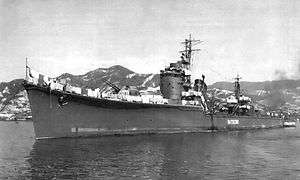 Natsuzuki in late 1945, after the war. | |
| History | |
|---|---|
 Empire of Japan Empire of Japan | |
| Name: | Natsuzuki |
| Builder: | Sasebo Naval Arsenal |
| Laid down: | 1 May 1944 |
| Launched: | 2 December 1944 |
| Completed: | 8 April 1945 |
| Commissioned: | 8 April 1945, 11th Destroyer Squadron |
| Struck: | 5 October 1945 |
| Fate: | Transferred to the United Kingdom, 25 August 1947 |
 United Kingdom United Kingdom | |
| Acquired: | 25 August 1947 |
| Fate: | Scrapped, 1948 |
| General characteristics | |
| Class and type: | Akizuki-class destroyer |
| Displacement: |
|
| Length: | 134.2 m (440 ft 3 in) |
| Beam: | 11.6 m (38 ft 1 in) |
| Draft: | 4.15 m (13 ft 7 in) |
| Propulsion: |
|
| Speed: | 33 knots (38 mph; 61 km/h) |
| Range: | 8,300 nmi (15,400 km) at 18 kn (21 mph; 33 km/h) |
| Complement: | 263 |
| Armament: |
|
Natsuzuki (夏月, "Summer Moon") was an Akizuki-class destroyer of the Imperial Japanese Navy.
Design and description
The Akizuki-class ships were originally designed as anti-aircraft escorts for carrier battle groups, but were modified with torpedo tubes and depth charges to meet the need for more general-purpose destroyer. Her crew numbered 300 officers and enlisted men. The ships measured 134.2 meters (440 ft 3 in) overall, with a beam of 11.6 meters (38 ft 1 in) and a draft of 4.15 meters (13 ft 7 in).[1] They displaced 2,744 metric tons (2,701 long tons) at standard load and 3,759 metric tons (3,700 long tons) at deep load.[2]
The ship had two Kampon geared steam turbines, each driving one propeller shaft, using steam provided by three Kampon water-tube boilers. The turbines were rated at a total of 52,000 indicated horsepower (39,000 kW) for a designed speed of 33 knots (61 km/h; 38 mph). The ship carried up to 1,097 long tons (1,115 t) of fuel oil which gave them a range of 8,300 nautical miles (15,400 km; 9,600 mi) at a speed of 18 knots (33 km/h; 21 mph).[3]
The main armament of the Akizuki class consisted of eight Type 98 100-millimeter (3.9 in) dual purpose guns in four twin-gun turrets, two superfiring pairs fore and aft of the superstructure. They carried four Type 96 25-millimeter (1.0 in) anti-aircraft guns in two twin-gun mounts. The ships were also armed with four 610-millimeter (24.0 in) torpedo tubes in a single quadruple traversing mount; one reload was carried for each tube. Their anti-submarine weapons comprised six depth charge throwers for which 72 depth charges were carried.[4]
Construction and career
On 5 October 1945, Natsuzuki was removed from the Navy List. On 25 August 1947, she was turned over to Great Britain. She was scrapped at Uraga, Kanagawa in 1948.
Notes
References
- Chesneau, Roger, ed. (1980). Conway's All the World's Fighting Ships 1922–1946. Greenwich, UK: Conway Maritime Press. ISBN 0-85177-146-7.
- Jentschura, Hansgeorg; Jung, Dieter & Mickel, Peter (1977). Warships of the Imperial Japanese Navy, 1869–1945. Annapolis, Maryland: United States Naval Institute. ISBN 0-87021-893-X.
- Whitley, M. J. (1988). Destroyers of World War 2. Annapolis, Maryland: Naval Institute Press. ISBN 0-87021-326-1.
External links
| Akizuki class | |||||||||||||||||||
|---|---|---|---|---|---|---|---|---|---|---|---|---|---|---|---|---|---|---|---|
| Fuyutsuki subclass | |||||||||||||||||||
| Mitchitsuki subclass |
| ||||||||||||||||||
| |||||||||||||||||||
| |||||||||||||||||||
| |||||||||||||||||||