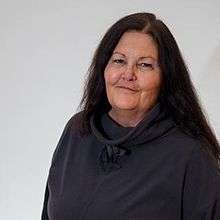
Jo-Ann Episkenew
| Jo-Ann Episkenew (née Thom) | |
|---|---|
 | |
| Born |
19 August 1952 Winnipeg, Manitoba |
| Died |
18 February 2016 (aged 63) Regina, Saskatchewan |
| Occupation | Educator |
| Nationality | Canadian |
| Ethnicity | Métis |
| Education | M.B.A., Ph.D. |
| Alma mater | University of Regina, Ernst-Moritz-Arndt University |
| Notable work | Taking Back Our Spirits; Indigenous Literature, Public Policy, and Healing |
| Notable awards | YMCA Regina Women of Distinction Lifetime Achievement Award |
Jo-Ann Episkenew (19 August 1952 – 18 February 2016) was a Métis woman originally from Manitoba, though she lived in Saskatchewan for much of her life.[1][2][3][4] She held a Masters of Business Administration and a Honours Certificate M.A. from the University of Regina. In 2006 she completed a Ph.D at Ernst-Moritz-Arndt University in Greifswald, Germany, the first Indigenous Canadian to receive a Ph.D from a German university.[5][6]
Career
Episkenew worked as a professor of English literature in the Department of English at the First Nations University of Canada.[4] She also served as the director of the Indigenous People's Health Research Centre at the University of Regina. She was a member of the Chotro International Consultative Group, a group that organizes bi-annual conferences on international Indigenous issues. She was on the Judicial Advisory Committee for Federal Judicial appointments for the Province of Saskatchewan.[5]
Her research included national and international projects in the area of Indigenous literature, Indigenous health and well being relating to the lives of Aboriginal and First Nations people of Canada.[7]
Publications
Her book, Taking Back Our Spirits; Indigenous Literature, Public Policy, and Healing was published by the University of Manitoba in 2009.[8] It won the Saskatchewan Book Award for Scholarly Writing in 2009; and the Saskatchewan Book Award for First People's Writing in 2010.[9]
The book was reviewed by Cheryl Suzack in University of Toronto Quarterly, who stated that it "analyzes the capacities of Indigenous literatures to "de-educate" both settler-colonial and Indigenous communities from the trappings of colonialism".[10]
Awards
Episkenew was awarded the YMCA Regina Women of Distinction Lifetime Achievement Award in 2015.[11] She received the Indspire Award for service to education, one of fourteen Indigenous Canadians selected in 2016.[12][13]
References
- ↑ "Educator, researcher Jo-Ann Episkenew dies at 63". CBC News. 18 February 2016.
- ↑ Johnson, April (20 February 2016). "Metis educator and researcher Jo-Ann Episkenew passes away at age 63". APTN National News. Retrieved 12 March 2016.
- ↑ Martin, Ashley (18 February 2016). "Friends and family remember Jo-Ann Episkenew, a passionate educator in indigenous health". Regina Leader-Post. Retrieved 12 March 2016.
- 1 2 She wrote of literature's power to heal Globe and Mail obituary by Patricia Dawn Robertson. April 1, 2016
- 1 2 "Annual Cultural Studies Speakers". The University of British Columbia. Retrieved 13 March 2016.
- ↑ "Remembering Dr. Jo-Ann Episkenew". Indspire. Retrieved 13 March 2016.
- ↑ "Kitinikêwin Misiwanacihisowin". Indigenous Peoples' Health Research Centre.
- ↑ "Taking Back Our Spirits". University of Manitoba Press.
- ↑ "Archived Awards". Saskatchewan Book Awards.
- ↑ Suzack, Cheryl (Summer 2012). "Taking Back Our Spirits: Indigenous Literature, Public Policy, and Healing (review)". University of Toronto Quarterly. 81 (3): 718–719. doi:10.1353/utq.2012.0029. ISSN 1712-5278.
- ↑ Jo-Ann Episkenew receives YWCA Lifetime Achievement Award. 27 April 2015 – via YouTube.
- ↑ "Dr. Jo-Ann Episkenew". Indspire.
- ↑ "Professor to receive prestigious Indspire Award". University of Regina. Retrieved 13 March 2016.