John Prichard
John Prichard (6 May 1817 – 13 October 1886) was a Welsh architect in the neo-Gothic style.[1] As diocesan architect of Llandaff, he was involved in the building or restoration of many churches in south Wales.
Biography
John Prichard was born in Llangan, Glamorgan, on 6 May 1817, the twelfth son of the rector Richard Prichard, who served as vicar-choral of Llandaff for 35 years.[2] He was descended from the Prichard family of Collenna.[3] John Prichard trained as an architect under Thomas Larkins Walker, and as a result was deeply influenced by the ideas of Augustus Pugin; much of his work was in a neo-Gothic style.[4]
He established a practice in Llandaff, Cardiff, becoming the official diocesan architect in 1847.[5][6] Between 1852 and 1863 he was in partnership with John Pollard Seddon. Many of his major commissions were restoration works, most famously for Llandaff Cathedral (1843–69); Prichard and Seddon worked on the cathedral from the 1840s until 1869, when the south-western tower was completed (to Prichard's own design).[7] Much of their work was destroyed by enemy bombing during the Second World War.[8]
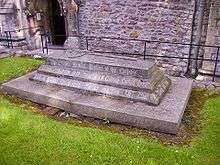
Prichard died, unmarried and childless, at the age of 69, and is buried on the south side of the cathedral.[9] On Prichard's death, Seddon succeeded him as diocesan architect.[10]
The Prichard Bridge, named after the architect, was built in about 1880 to allow carriages to cross the feeder channel between the River Taff and the Llandaff corn mill.[11] It is a Grade II listed building. The mill was demolished in about 1932 and the stream no longer exists; the lower part of the bridge is buried and no longer visible.[12]
One of the few secular buildings on which Prichard & Seddon worked was Ettington Park, where Prichard's brother Richard was vicar.[13] Prichard also designed Nazareth House, a Catholic almshouse built on land donated by John Crichton-Stuart, 3rd Marquess of Bute. The chapel of the latter was not Prichard's work; it was added later.[14]
Buildings
- Llandaff Cathedral, Llandaff (1843–1869) restoration.[9]
- Prichard Bridge, Llandaff (c.1880)[15]
- Nazareth House, Cardiff (1875)
- St Cadfan's Church, Tywyn (1877) restoration.[16]
- Church of St Swithin, Ganarew (1850)[17]
- Church of the Holy Cross, Cowbridge (1850–1852) restoration.[18]
- St Michael's Church, Cwmafan (1851).[19]
- The Church of St Julius and Aaron, Llanharan (1856–1859) restoration.[20][21]
- Ettington Park, near Stratford upon Avon (1858–1862) restoration.[13]
- Church of St John, Llandenny (1860-5) with John Pollard Seddon
- St Margaret's Church, Roath (1870) commissioned by the Marquess of Bute[22]
- St Crallo, Coychurch (1871) restoration[23]
- Church of SS. Illtyd, Gwynno & Tyfodwg, Llantrisant (1874) restoration[24]
- St Catharine's Church, Baglan (1875–1882) restoration[25]
- Church of St Thomas a Becket, Monmouth (1876)[26]
- St Mary's Nolton, Bridgend (completed 1877) build[27]
- St Mary's on Chapel Hill, Tintern, Monmouthshire (1863–1868) restoration[28]
References
- ↑ The Welsh Academy Encyclopaedia of Wales. John Davies, Nigel Jenkins, Menna Baines and Peredur Lynch (2008) p.710. ISBN 978-0-7083-1953-6
- ↑ Ellis, Megan. "John Prichard". Welsh Biography Online. National Library of Wales. Retrieved 20 April 2016.
- ↑ "Prichard family of Collenna, Llantrisant,papers". Glamorgan Archives. National Library of Wales. Retrieved 20 April 2016.
- ↑ "John Prichard (1818-1886)". Stained Glass in Wales. University of Wales. Retrieved 21 April 2016.
- ↑ John B. Hilling (1976). The historic architecture of Wales: an introduction. University of Wales Press. ISBN 978-0-7083-0626-0.
- ↑ John Newman (2000). The Buildings of Wales: Gwent/Monmouthshire. Yale University Press. p. 56. ISBN 9780300096309.
- ↑ The Architect and Building News. 1873. pp. 118–.
- ↑ John Newman; Stephen R. Hughes; Anthony Ward (1995). The Buildings of Wales: Glamorgan (Mid Glamorgan, South Glamorgan and West Glamorgan). Yale University Press. p. 92. ISBN 9780140710564.
- 1 2 "History". Llandaff Cathedral. Retrieved 20 April 2016.
- ↑ The Red Dragon: The National Magazine of Wales. Daniel Owen, Howell and Company. 1886.
- ↑ "Prichard Bridge". People's Collection Wales. Retrieved 20 April 2016.
- ↑ "Bridge to north extension of Graveyard of Cathedral of Ss Peter and Paul, Llandaff". British Listed Buildings. Retrieved 20 April 2016.
- 1 2 Geoffrey Tyack (1 January 1994). Warwickshire Country Houses. Phillimore. ISBN 978-0-85033-868-3.
- ↑ John Newman; Stephen R. Hughes; Anthony Ward (1995). Glamorgan: (Mid Glamorgan, South Glamorgan and West Glamorgan). Penguin Books; University of Wales Press. pp. 285–. ISBN 978-0-14-071056-4.
- ↑ Cadw List Description
- ↑ Meryl Gover (28 April 2015). Cadfan's Church: A History with Digressions. Troubador Publishing Ltd. pp. 147–. ISBN 978-1-78462-290-9.
- ↑ Royal Commission on Historical Monuments (England); Crawford, David Lindsay (1934). An inventory of the historical monuments in Herefordshire. H. M. Stationery off., printed by William Clowes & sons, ltd. p. 96. Retrieved 25 March 2012.
Parish Church of St. Swithin, was entirely rebuilt in 1850...
- ↑ The Welsh Academy Encyclopaedia of Wales p.174
- ↑ The Welsh Academy Encyclopaedia of Wales p.181
- ↑ "Church of SS Julius and Aaron, Llanharan". British Listed Buildings. Retrieved 21 April 2016.
- ↑ The Welsh Academy Encyclopaedia of Wales p.500
- ↑ Childs, Jeff (2012). Roath, Splott and Adamsdown: One Thousand Years of History. History Press. ISBN 9780752482576.
- ↑ Newman (1995) p.334
- ↑ The Welsh Academy Encyclopaedia of Wales p.507
- ↑ The Welsh Academy Encyclopaedia of Wales p.46
- ↑ "Church of St Thomas, Monmouth, Monmouthshire". Stained Glass in Wales. llgc.org.uk.
- ↑ The Welsh Academy Encyclopaedia of Wales p.83
- ↑ "Former Church of St Mary, Tintern". British Listed Buildings. Retrieved 20 April 2016.
Bibliography
- Davies, John; Jenkins, Nigel; Menna, Baines; Lynch, Peredur I., eds. (2008). The Welsh Academy Encyclopaedia of Wales. Cardiff: University of Wales Press. ISBN 978-0-7083-1953-6.
- Newman, John (1995). Glamorgan. London: Penguin Group. ISBN 0140710566.