Jor-bangla
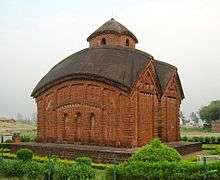
Jor-Bangla Temple or Keshta Roy Temple (c. 1655), Bishnupur, Bankura dist., West Bengal, India.
Jor-bangla, also called yorubangala, is a style of temple architecture that arose in Bengal.[1] The style involves two structures that resemble the traditional village huts of the region, one that serves as a porch, in front of the other that serves as a shrine.[1] Each structure has a roof of the ek-bangla (or do-chala) style, with two curved segments that meet at a curved ridge.[2]
Notable examples
- Gopinath Jor-Bangla is a Hindu temple located 1 kilometre (0.62 mi) south of Pabna town in Bangladesh. There is no reliable information about the date when it was built, possibly in the 19th century.[3] It is one of the major archaeological attractions of the Pabna District.
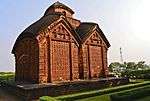
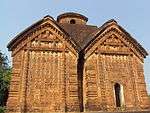
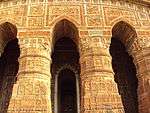
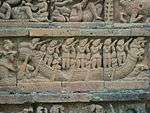
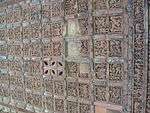
- Bishnupur Jor-Bangla temple, built 1655 by King Raghunath Singha Dev. It is richly ornamented with terracotta carvings. The roof has the classic chala style of Bengal architecture.[4][5][6][7]
 |
 |
 |
 |
 |
See also
- Char-chala style has a roof with four curved, triangular pieces that meet at a point.
References
 |
Wikimedia Commons has media related to Jor Bangla Architecture. |
- 1 2 Priyanka Mangaonkar (2012). "Temples of Bengal: Material Style and Technological Evolution" (PDF). Chitrolekha International Magazine On Art And Design. 2 (1). Archived from the original (PDF) on 27 August 2013.
- ↑ Amit Guha, Classification of Terracotta Temples, retrieved 30 January 2016
- ↑ Mrinmoyee Ray (2012). "Representation in Monument Building and Schematic of Terracotta Narratives: Delving into Some Aspects of Gopinath Jor-Bangla Temple, Pabna, Bangladesh" (PDF). Chitrolekha International Magazine On Art And Design. 2 (1).
- ↑ Dasgupta 2009, p. 37.
- ↑ Malabhum, Bishnupur-Chandra, Manoranjan; 2004; Kolkata. Deys Publishing ISBN 8129500442
- ↑ History of Bishnupur Raj-Malick Abhaayapada. 1982, West Bengal
- ↑ "Bishnupur Sub-division". bankura.gov.in.
Sources
- Dasgupta, Gautam Kumar; Biswas, Samira,; Mallik, Rabiranjan, (2009), Heritage Tourism: An Anthropological Journey to Bishnupur, A Mittal Publication, p. 20, ISBN 8183242944
- Ghosh, P. (2005). Temple To Love: Architecture And Devotion In Seventeenth-Century Bengal. Indiana University Press. ISBN 9780253344878.
This article is issued from Wikipedia - version of the 4/17/2016. The text is available under the Creative Commons Attribution/Share Alike but additional terms may apply for the media files.