Julio Cesar Firrufino
| Julio Cesar Firrufino | |
|---|---|
|
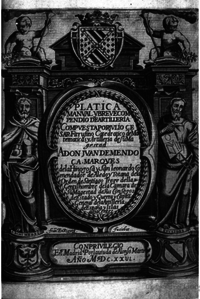
Front page of Platica (1626) | |
| Born |
ca 1578 probably Seville, Spain |
| Died |
March 9, 1651 (aged 72) Madrid, Spain |
| Fields | Mathematics, Artillery |
| Notable students | Luis Carducho |
Julio Cesar Firrufino or Ferrufino (16th century) was an engineer and mathematician who had a chair in mathematics in Madrid from 1604 to 1650.
Life and work
He was the son of Julian Firrufino (ca 1535–1604), born in Alessandria (Duchy of Milan) who had also a chair in Geometry and Artillery granted by the king of Spain.[1] However, we know few biographical data of Julio Cesar, his son.[2] Only from a document dated 1644, we know he was 66 years old, so we can suppose he was born in 1578, when his father had a chair of Naval Artillery in the Casa de Contratación and, probably, he was born in Sevilla.[3]
In 1600 he was assistant of the Spanish minister of Artillery[4] and from 1604, after the death of his father, he was appointed to a chair on Mathematics and Fortification,[5] after the approval of Andrés García de Céspedes and João Baptista Lavanha who examined him.[6] He was in charge of the chair until 1650, one year before his death; in this date he was replaced by his student Luis Carduchi, member of a family of old friends of Firrufino.[7]
In 1626 he published Plática Manual y Breve Compendio de Artillería, which was an abstract of a treatise of artillery that he was not allowed to publish by political reasons.[8]
In 1638 he was accused by fraud in the production of 66 artillery guns in Sevilla; for this reason he was imprisoned during some time in 1644.[9]
In 1648 was published his most important work: El perfecto artillero, which is an encyclopedic treatise, but not much original, based in Tartaglia ideas.[10]
References
- ↑ Vicente Maroto, page 8.
- ↑ Díaz Moreno, page 172.
- ↑ Díaz Moreno, page 174.
- ↑ Díaz Moreno, page 175.
- ↑ It is not clear in which academic institution, see Díaz Moreno, pages 177–178.
- ↑ Capel, Sánchez & Moncada, page 99.
- ↑ Díaz Moreno, pages 179–180.
- ↑ Díaz Moreno, pages 181–182.
- ↑ Díaz Moreno, pages 183 i ss.
- ↑ Navarro Loidi, page 596.
Bibliography
- Capel Saez, Horacio; Sanchez, Joan-Eugeni; Moncada, Omar (1988). De Palas a Minerva: la formación científica y la estructura institucional de los ingenieros militares en el siglo XVIII (in Spanish). Ediciones del Serbal i CSIC. ISBN 84-00-06829-7.
- Díaz Moreno, Felix (2000). "Teórica y práctica del arte de la guerra en el siglo XVII hispano. Julio César Firrufino y la artillería". Anales de Historia del Arte (in Spanish). 10: 169–205. ISSN 0214-6452.
- Navarro Loidi, Juan (1997). "El movimiento de los proyectiles y los escritos de los militares españoles del siglo XVII". In Georgina Blanes i Nadal, Lluís Garrigós i Oltra (coords.). Actes de les IV trobades d'història de la ciència i de la tècnica (in Spanish). Societat Catalana d'Història de la Ciència i de la Tècnica. pp. 595–608. ISBN 84-7283-391-7.
- Vicente Maroto, M. Isabel (2003). "Las escuelas de artillería en los siglos XVI y XVII". Quaderns d'història de l'enginyeria (in Spanish). 5: 1–9. ISSN 1135-934X.
External links
- Firrufino, Julio César. "Platica Manual y Breve Compendio de Artilleria". Google books (in Spanish). Retrieved 7 November 2015.
- de Noort, Juan. "Portrait of Julio César Firrufino". Europeana. Retrieved 7 November 2015.