Junctional tachycardia
| Junctional tachycardia | |
|---|---|
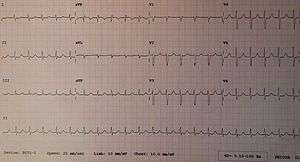 | |
| ECG showing junctional tachycardia. Narrow complex QRS. No P waves. Heart rate fast. | |
| Classification and external resources | |
| ICD-10 | I47.1 |
| ICD-9-CM | xxx |
Junctional tachycardia is a form of supraventricular tachycardia characterized by involvement of the AV node.[1] It can be contrasted to atrial tachycardia. It is a tachycardia associated with the generation of impulses in a focus in the region of the atrioventricular node due to an A-V disassociation.[2] In general, the AV junction's intrinsic rate is 40-60 bpm so junctional tachycardia implies a rate >60 bpm.
Cause
It can be associated with digitalis toxicity.[3] It may be also be due to onset of acute coronary syndrome, heart failure, conduction system diseases with enhanced automaticity, or administration of theophylline.[4]
Diagnosis
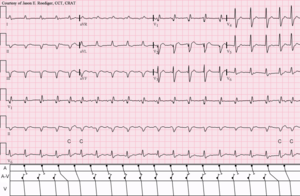
On an EKG, Junctional Tachycardia exhibits the following classic criteria:[2]
- P-Waves: The p-wave may be inverted in leads II, III and aVf or not visible
- Narrow QRS complexes (which is consistent with non-ventricular rhythms)
It can coexist with other superventricular tachycardias due to the disassociation between the SA node and the AV node. Junctional Tachycardia can appear similar to atrioventricular nodal reentrant tachycardia.[5]
One form is junctional ectopic tachycardia.
See also
References
- ↑ "junctional tachycardia" at Dorland's Medical Dictionary
- 1 2 ROSEN, KENNETH (1973). "Junctional Tachycardia: Mechanisms, Diagnosis, Differential Diagnosis, and Management" (PDF). Circulation: 654–664. doi:10.1161/01.CIR.47.3.654. Retrieved March 1, 2015.
- ↑ "Junctional Rhythm: Overview - eMedicine". Retrieved 2008-12-21.
- ↑ Aehlert, Barbara (2013). ECGs Made Easy (5th ed.). Elsevier. p. 160. ISBN 9780323170574.
- ↑ Srivathsan K, Gami AS, Barrett R, Monahan K, Packer DL, Asirvatham SJ (January 2008). "Differentiating atrioventricular nodal reentrant tachycardia from junctional tachycardia: novel application of the delta H-A interval". J. Cardiovasc. Electrophysiol. 19 (1): 1–6. doi:10.1111/j.1540-8167.2007.00961.x. PMID 17916156.