Upper Silesian metropolitan area
| Upper Silesian metropolitan area obszar metropolitalny konurbacji górnośląskiej Slezská Metropolitní oblast | |
|---|---|
 | |
| Country | Poland |
| Region | Silesian Voivodeship |
| Largest Cities |
Katowice Sosnowiec Gliwice Zabrze Bytom |
| Area | |
| • Metro | 1,586,16 km2 (61,242 sq mi) |
| Population | |
| • Metro | 2,204,325 |
| • Metro density | 14/km2 (36/sq mi) |
| Time zone | CET (UTC+1) |
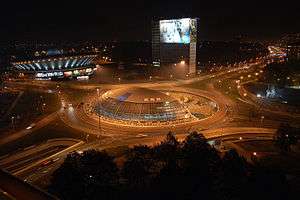
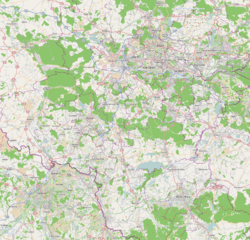
The Upper Silesian metropolitan area is a metropolitan area in southern Poland and northeast Czech Republic, centered on the cities of Katowice and Ostrava in Silesia. Located in the three administrative units (NUTS-2 class): mainly Silesian Voivodeship, small western part of Lesser Poland Voivodeship and small east part of Moravian-Silesian Region.
The area lies within the Upper Silesian Coal Basin. Silesian metropolitan area (5.3 million people) with nearby Kraków metropolitan area (1.3 million[1][2][3][4][5] people) and Częstochowa metropolitan area (0.4 million[1][2][3] people) create a great metropolitan area covering 7 million people.
Statistics
Upper Silesian metropolitan area has a population of 5,294,000, with 4,311,000 (81.43%) in Poland (the Upper Silesian polycentric metropolitan area) and 983,000 (18.57%) in the Czech Republic (Ostrava Functional Urban Area).[1] According to Polish Scientific Publishers (PWN) area is 5,400 km², with 4,500 km² (83.33%) in Poland and 900 km² (16.67%) in the Czech Republic.[6]
The area consists of several Functional Urban Areas (FUA), each of which is defined as a core Morphological Urban Area (MUA) based on population density plus the surrounding labour pool, i.e. a metropolitan area. This area contains the following FUAs:[1]
- Katowice FUA: 3,029,000 (see also Katowice urban area); within Upper Silesian Industrial Region
- Bielsko-Biała FUA and Cieszyn FUA: 647,000 (584,000 + 63,000); within north of Cieszyn Silesia and Bielsko Industrial Region
- Rybnik FUA and Racibórz FUA: 634,000 (526,000 + 109,000); within Rybnik Coal Area
- Ostrava FUA: 983,000; within Ostrava-Karviná Coal Area
Data may vary depending on the source, example for same the Katowice city exist sources for 3.5 million people;[7][8] for the Rybnik - 507,000,[3] while for the Ostrava - 1,153,876.[2]
Economy
Historically, most of the area was characterized by heavy industry since the age of industrialisation in the late 19th and early 20th century. Except carbon, it also contains a number of other minable resources (methane, cadmium, lead, silver and zinc). Resources of coal to a depth to 1000 meters - about 70 billion tons, the conditions for the extraction - good.[6]
See also
- Rhine-Ruhr
- Katowice urban area, part of the Upper Silesian metropolitan area
- Upper Silesian Industrial Region
- Silesian Metropolis, a political and economic association of local municipalities
References
- 1 2 3 4 (English) European Spatial Planning Observation Network (ESPON) "ESPON project 1.4.3. Study on Urban Functions" - Final report, March 2007, ISBN 2-9600467-2-2
- 1 2 3 (English) Eurostat, Urban Audit database, accessed on 2009-03-12. Data for 2004.
- 1 2 3 (Polish) "Społeczne i polityczne zróżnicowanie aglomeracji w Polsce" - Paweł Swianiewicz, Urszula Klimska; University of Warsaw 2005
- ↑ (Polish) Funkcje Metropolitalne Pięciu Stolic Województw Wschodnich - Tadeusz Markowski
- ↑ (Polish) "Koncepcja przestrzennego zagospodarowania kraju" - Ministry of Regional Development, 2003
- 1 2 (Polish) "Górnośląskie Zagłębie Węglowe" - PWN Encyclopedia
- ↑ (English) www.worldatlas.com
- ↑ (Polish) "Górnośląski Okręg Przemysłowy" - PWN Encyclopedia
Silesia topics | |||||||||||||||||||||||||||||||||||||||||||||||
|---|---|---|---|---|---|---|---|---|---|---|---|---|---|---|---|---|---|---|---|---|---|---|---|---|---|---|---|---|---|---|---|---|---|---|---|---|---|---|---|---|---|---|---|---|---|---|---|
| |||||||||||||||||||||||||||||||||||||||||||||||
| |||||||||||||||||||||||||||||||||||||||||||||||
| |||||||||||||||||||||||||||||||||||||||||||||||
| |||||||||||||||||||||||||||||||||||||||||||||||
| |||||||||||||||||||||||||||||||||||||||||||||||


Coordinates: 50°15′00″N 19°00′00″E / 50.2500°N 19.0000°E